Every manufacturer understands the cost of a misaligned part or a reworked assembly. When you’re running hundreds or thousands of parts per shift, even minor inconsistencies compound quickly, increasing scrap, slowing throughput, and frustrating your team on the floor.
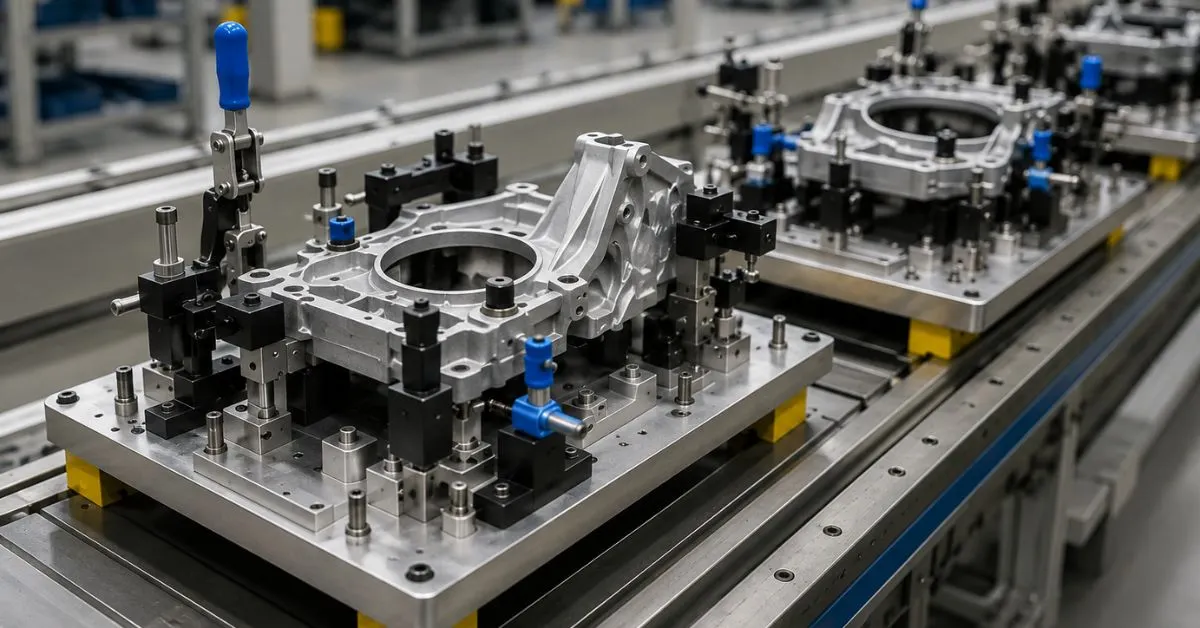
Assembly line fixtures solve that problem. By securely holding, positioning, and supporting workpieces during assembly operations, fixtures ensure that every part is machined, assembled, or inspected consistently, every single time. They are fundamental to precision manufacturing, lean production, and scalable output.
Whether you’re building agricultural equipment in rural Ohio, assembling medical devices, or running a high-volume automotive line, assembly line fixtures directly affect the quality and efficiency of your operation. This guide breaks down what fixtures are, how they’re used, how to choose the right type, and what to look for when working with a fixture manufacturer.
What Are Assembly Line Fixtures?
An assembly line fixture is a work-holding device designed to locate, support, and clamp a workpiece in a fixed, repeatable position during manufacturing. Unlike jigs, which guide cutting tools, fixtures hold the part in place while work is performed on or around it.
In practical terms, a fixture might hold a steel bracket while it’s welded to a frame, secure a housing while components are pressed in, or orient a subassembly precisely for robotic fastening. The fixture does not guide the tool; it ensures the workpiece is where it needs to be.
Manufacturers use assembly fixtures for several reasons:
- Repeatability: every part is positioned identically, eliminating operator variation
- Accuracy: tight tolerance control without relying on individual skill
- Speed: faster setup and cycle times compared to manual positioning
- Safety: stable clamping reduces handling risk
- Quality: fewer defects mean lower rework and scrap costs
In modern manufacturing, assembly line fixtures are critical infrastructure. They support automation, robotic assembly, and lean workflows by standardizing how work gets done.
Types of Assembly Line Fixtures Used in Manufacturing
Not all fixtures are built the same. The right type depends on your production volume, part complexity, and process requirements. Here are the main categories:
Manual Fixtures
Manual fixtures use hand-operated clamps, levers, or toggle mechanisms to secure workpieces. They’re cost-effective for low-volume or prototype work where manual loading and unloading make sense. Common in job shops and small-batch production environments.
Modular Fixtures
Modular fixtures are built from standardized, interchangeable components that can be reconfigured for different parts. They work well in flexible manufacturing environments where product lines change frequently. Setup time is longer than dedicated fixtures, but the component reuse offsets tooling costs over time.
Dedicated Fixtures
Dedicated fixtures are purpose-built for a single part or assembly. They offer the highest accuracy and fastest cycle times. For high-volume production, like an automotive stamping line running 50,000 units per year, dedicated fixtures deliver consistent results with minimal operator input.
Pneumatic Fixtures
Pneumatic fixtures use air pressure to actuate clamps, making them faster and more consistent than manual clamping. They integrate well with automated lines and reduce operator fatigue in high-cycle applications. Widely used in automotive and appliance assembly.
Hydraulic Fixtures
Hydraulic fixtures generate higher clamping forces than pneumatic systems, making them suitable for heavy weldments, structural fabrications, and applications where vibration or machining forces could shift the workpiece. Common in heavy equipment and steel fabrication.
Automated and Robotic Assembly Fixtures
These fixtures are engineered for integration with robotic arms, collaborative robots (cobots), or automated assembly cells. They feature precision locating pins, automated clamps, and sensor interfaces to ensure parts are correctly seated before the robot acts. Critical in automotive, medical device, and electronics manufacturing.
Custom Assembly Fixtures
When standard tooling solutions don’t meet part geometry, accuracy, or workflow requirements, custom assembly fixtures are designed and built from scratch. Custom fixtures can accommodate irregular part shapes, multi-axis positioning, integrated gauging, and process-specific requirements that off-the-shelf options simply can’t address.
Common Uses of Assembly Fixtures Across Industries
Assembly fixtures are used in virtually every manufacturing sector. Here’s how different industries rely on them:
Automotive
Automotive manufacturers depend on production line fixtures at nearly every station, from body-in-white welding and door hinge assembly to brake system installation. Tight tolerances, high volumes, and mixed-model production make precision fixtures essential for maintaining quality and cycle time targets.
Agriculture Equipment
Agricultural equipment manufacturers use industrial assembly fixtures to hold large frame weldments, PTO assemblies, and implement components during fabrication and assembly. Ohio’s robust agricultural equipment industry, including manufacturers in the northwest and central regions, frequently relies on custom manufacturing fixtures to handle the oversized, heavy-duty components typical of this sector.
Medical Devices
Precision assembly fixtures in the medical device space hold delicate components during bonding, welding, or inspection. Traceability and cleanliness requirements demand fixtures built to tight dimensional specifications, often from stainless steel or anodized aluminum.
Food Processing Equipment
Fixture design for food processing equipment must account for sanitary construction, no dead zones, easy washdown access, and materials approved for food-contact environments. Fixtures used to assemble processing equipment help maintain the tolerances needed for consistent sealing and flow performance.
Energy and Industrial Equipment
Power generation, oil and gas, and industrial equipment manufacturers use hydraulic and pneumatic fixtures to assemble large valve bodies, pump housings, and structural frames. Assembly fixtures keep heavy components properly oriented during welding and machining, preventing costly distortion and rework.
Steel Fabrication
Steel fabricators use weld fixtures and assembly jigs to hold structural members, tubes, and plates in precise position before and during welding. This prevents weld-induced distortion, improves dimensional consistency, and speeds up the fit-up process significantly.
Benefits of Assembly Line Fixtures
The case for investing in proper assembly fixtures is straightforward when you look at the production metrics:
- Improved consistency: Parts are positioned the same way every cycle, eliminating variation that comes from manual setup.
- Higher productivity: Operators spend less time adjusting and re-measuring, which shortens cycle times and increases throughput.
- Better accuracy: Fixtures enforce the required tolerances without depending on individual operator judgment.
- Reduced operator fatigue: Clamps and supports take the physical strain out of holding heavy or awkward assemblies.
- Faster production: Streamlined loading, clamping, and unloading sequences cut setup time per part.
- Improved quality control: Consistent positioning leads to predictable weld quality, joint alignment, and dimensional conformance.
- Lower manufacturing costs: Fewer defects and less rework translate directly to reduced scrap and lower cost per unit.
For high-volume manufacturers, the return on investment for a well-designed fixture is often realized within the first production run. For lower-volume shops, fixtures reduce the skill level required at individual stations, which improves workforce flexibility.
How to Choose the Right Assembly Line Fixture
Selecting the right fixture requires evaluating several production and engineering factors before committing to a design:
- Production volume: High-volume lines justify dedicated fixtures with faster cycle times. Modular or manual fixtures may better serve low-volume or prototype work.
- Part complexity: Complex geometries with multiple datum surfaces require more sophisticated locating schemes. Simpler parts may only need basic clamping.
- Material: Heavier or harder materials, like structural steel or cast iron, require higher clamping forces. Delicate parts like aluminum castings or plastics need controlled clamping to avoid deformation.
- Accuracy requirements: If tolerances are tight, the fixture itself must be built to a higher precision level. The fixture’s accuracy should exceed the part tolerance by a meaningful margin.
- Automation compatibility: If the assembly cell uses robots or automated handling, the fixture must interface with those systems, including sensor ports, datum pins, and clamp actuation.
- Maintenance: A fixture that’s difficult to clean, adjust, or repair will create downtime. Design for accessibility and wear replacement.
- Scalability: Can the fixture be modified or replicated if production volumes increase or part designs change slightly?
- Budget: Balance the upfront tooling cost against production savings. A higher-cost fixture that cuts cycle time by 15% may pay for itself within weeks on a busy line.
Custom Assembly Fixtures vs. Standard Fixtures
One of the most common questions manufacturers face is whether to purchase standard tooling or invest in custom assembly fixtures. The answer depends on your production requirements.
|
Feature |
Standard Fixtures | Custom Fixtures |
|
Upfront Cost |
Lower | Higher |
|
Part Fit |
Generic | Exact geometry match |
|
Accuracy |
Moderate | High / application-specific |
| Cycle Time | Slower setup |
Optimized for your process |
| Automation Fit | Limited |
Designed to spec |
| Flexibility | High (modular) |
Low (dedicated) |
| Best For | Prototype, low-volume, general use |
High-volume, precision, complex parts |
When custom fixtures are worth the investment: If your part has a unique geometry, requires tight tolerances, runs at high volume, or needs to integrate with an automated cell, custom assembly fixtures typically outperform standard tooling in every measurable way. The initial engineering cost is recovered quickly through reduced cycle times, fewer defects, and less operator dependency.
How Ohio Manufacturers Can Improve Production Efficiency with Assembly Line Fixtures
Ohio is one of the most manufacturing-intensive states in the country. Automotive suppliers, agricultural equipment OEMs, industrial machinery producers, metal fabricators, and tier-1 contractors all operate across the state, and they all share a common challenge: maintaining production efficiency as parts become more complex and customer expectations increase.
Automotive suppliers across the I-75 corridor know that assembly line tooling reducing station-to-station variation directly impacts OEM quality ratings. Meanwhile, agricultural equipment manufacturers in northwest Ohio rely on heavy-duty fixture design for large weldments to control distortion and keep fit-up times manageable. Ultimately, metal fabricators and OEM manufacturers throughout the state find that the right production fixtures reduce the time operators spend on manual setup, freeing capacity for higher-value work.
The common thread: manufacturing companies in Ohio that invest in well-engineered assembly fixtures gain measurable advantages in throughput, quality, and cost, not as a theory, but as a documented result from facilities that have made that transition.
Why Experience Matters When Choosing an Assembly Fixture Manufacturer
The design and manufacture of assembly fixtures is an engineering discipline, not just a fabrication task. Much of what applies to choosing a precision fabrication partner for sheet metal work applies here too; the best fixtures come from manufacturers who understand not only how to build them but also how your production process works and what your part actually needs.
Key factors to evaluate when selecting a fixture manufacturer:
- Engineering expertise: Can they analyze your part drawings, identify datum strategies, and recommend clamping solutions, or do they simply build from whatever you send them?
- Quality standards: Are fixtures built to documented dimensional standards with inspection records? Will they meet your in-house quality requirements?
- Manufacturing experience: Have they built fixtures for your type of application? Experience across industries, automotive, agriculture, and industrial equipment, means a manufacturer has solved problems similar to yours.
- Design collaboration: The best outcomes come from early collaboration between your engineers and the fixture manufacturer. This prevents costly design revisions after tooling is built.
- Long-term reliability: A fixture that works for 10,000 cycles matters less if it fails at 50,000. Material selection, wear components, and maintainability all contribute to fixture longevity.
- Production scalability: If your volumes grow or your part design evolves, can your fixture manufacturer support updates, modifications, or second-unit builds?
Rialto Manufacturing Inc has been designing and building custom assembly line fixtures for over 40 years, serving manufacturers across Ohio and the broader Midwest. Their engineering team collaborates directly with customers from the concept stage through production validation, ensuring that each fixture performs to the specific demands of the application, not just the drawing.
Frequently Asked Questions
How long does it take to design and build a custom assembly fixture?
Lead times vary based on complexity, but most custom fixtures go through concept design, engineering review, fabrication, and runoff testing. Simple fixtures might be ready in 4–6 weeks; complex multi-station or automated fixtures can take 12–16 weeks or more.
What materials are assembly fixtures typically made from?
Most fixtures are built from steel, aluminum, or cast iron, depending on clamping force requirements, weight constraints, and environment. Aluminum is popular for lighter-duty or ergonomic applications; hardened steel is used where wear resistance is critical.
How do you maintain assembly fixtures to extend their service life?
Regular inspection of locating pins, clamp mechanisms, and wear pads is essential. Most fixtures are designed with replaceable wear components, so the entire fixture doesn’t need to be rebuilt when a single element wears out.
Can existing assembly fixtures be modified if the part design changes?
Yes, in many cases. Minor design changes can often be accommodated through modifications to locating pins, clamp positions, or nest inserts rather than a full rebuild, provided the fixture was designed with future flexibility in mind.
What is fixture runoff, and why does it matter?
Fixture runoff is a validation process where the fixture is tested with actual production parts before full deployment. It confirms that the fixture locates correctly, clamps consistently, and produces parts within tolerance, catching issues before they affect a production run.
Conclusion
Whether you’re running automotive subassemblies, agricultural equipment components, or industrial fabrications, the right assembly line fixtures directly affect your cost per part, your scrap rate, and your ability to scale production reliably.
For manufacturers evaluating new fixture tooling or reconsidering aging setups that no longer match your production demands, the best starting point is a conversation with an experienced assembly fixture manufacturer who can assess your application and recommend a solution designed around your specific process.
Ready to optimize your assembly line? Contact us today to speak with an engineering expert about your custom fixturing needs.[/vc_column_text][/vc_column][/vc_row]