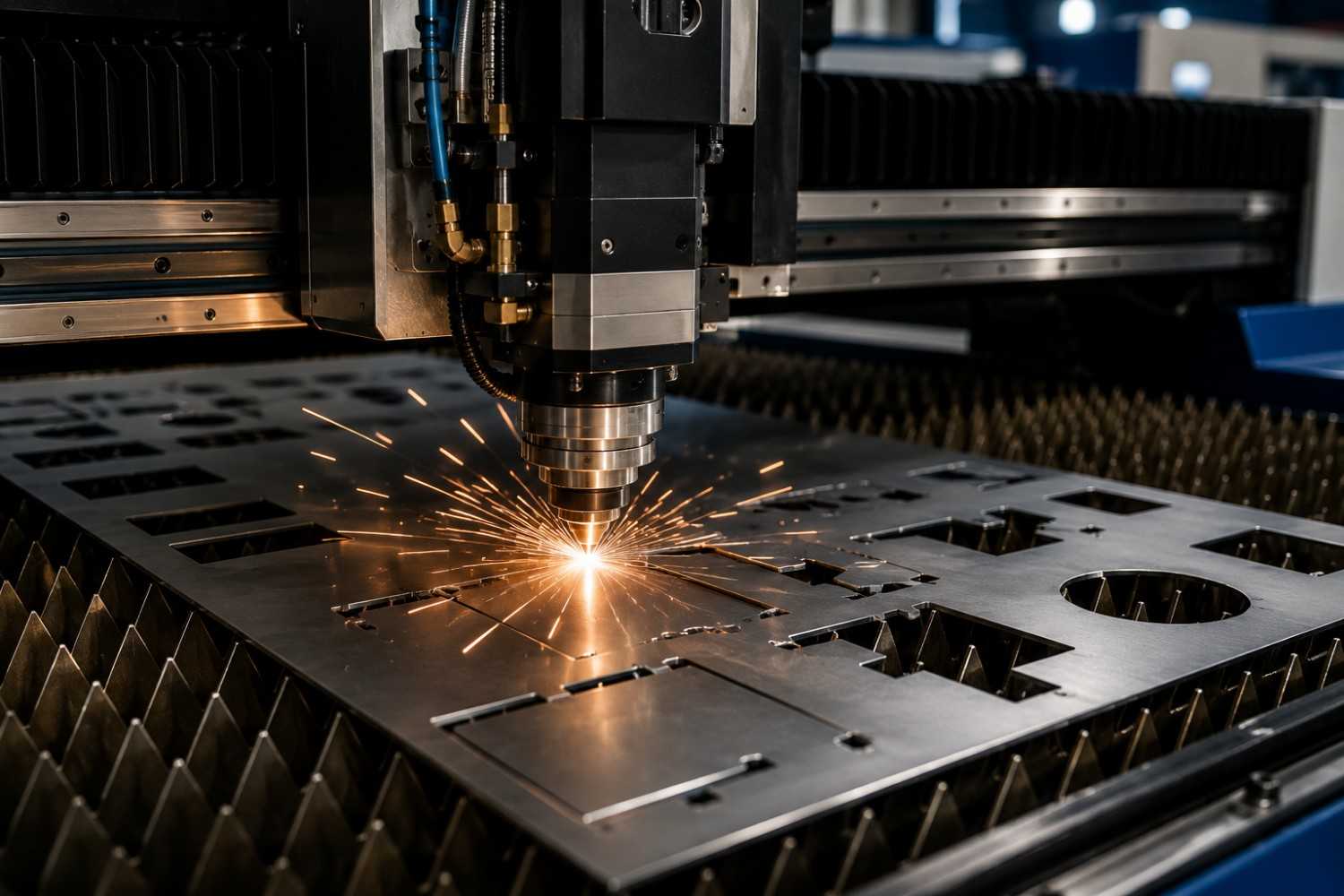
Laser-cut metal parts typically run from a few dollars per piece for simple mild steel brackets in volume, up to $50 or more per piece for complex, tight-tolerance stainless or aluminium parts in low quantities. There is no flat per-hour or per-cut price; cost is calculated per job from material, machine time, quantity, and any secondary operations like bending or welding.
There’s no single laser cutting price list, and any shop that quotes one number without seeing your part is guessing. That per-job calculation is exactly why two quotes for what looks like “the same part” can land far apart.
Key Takeaways
- Laser cutting cost is built from material, machine time, setup, and secondary operations, not a flat per-hour or per-cut rate.
- Material and finishing (bending, welding, coating) typically outweigh raw laser time in total project cost.
- Larger batch quantities lower per-part cost because setup time is fixed regardless of run size.
- Getting a full-job quote from one integrated shop, rather than separate laser, bending, and welding vendors, usually costs less than it appears once handoff markups are counted.
- A complete quote package (drawing, material, quantity, tolerance, finish) gets a real number back; an incomplete one gets a padded estimate.
This guide breaks down what actually drives a quote for precision CNC laser cutting, gives you the formula shops use internally to build one, and tells you what to hand a fabricator so your first quote is accurate instead of a rough guess you’ll have to renegotiate later.
What Drives Laser Cutting Cost
| Cost Driver | Impact on Price |
|---|---|
| Material type & thickness | Highest impact; stainless and aluminium cost more than mild steel to cut and buy. |
| Part complexity & pierce count | More cuts, holes, and intricate geometry = more machine time. |
| Quantity/batch size | Per-part price drops as volume rises; setup cost is fixed regardless of run size. |
| Tolerance requirements | Tighter tolerance can mean slower cutting speed and added inspection time. |
| Material utilization (nesting) | Poor nesting wastes sheet, which shows up directly in your quote. |
| Secondary operations | Bending, welding, and finishing sit on top of the base cutting cost. |
| Assist gas type | Nitrogen (stainless/aluminum) costs more per hour than oxygen (carbon steel). |
| Lead time/rush requests | Expedited turnaround typically adds a premium. |
How Is Laser Cutting Priced? The Cost Formula Explained
At the shop level, a laser cutting quote is generally built as:
Total Cost = Material Cost + (Machine Time × Hourly Rate) + Setup Cost + Secondary Operations
- Material cost is sheet price per pound or per square foot, adjusted for how efficiently your parts nest on the sheet.
- Machine time is driven by total cut length, pierce count, and material thickness; a laser cuts a fixed length per minute depending on power and material, so more cut path means more billed time.
- Setup cost covers programming and material loading, and it’s fixed whether you order 1 part or 500, which is exactly why larger batches cost less per piece.
- Secondary operations, deburring, bending, welding, powder coating get added after the base cut, and for many parts this ends up being the majority of total project cost, not the laser time itself.
Industrial fiber laser shops typically bill machine time in the range of roughly $100–$250 per hour depending on laser power and regional labor cost, though this figure alone tells you little without knowing your part’s actual cut time and material use, which is why an itemized quote matters more than a quoted hourly rate.
What Factors Actually Move Your Laser Cutting Price?
1. Material type and thickness: Mild carbon steel is the cheapest baseline; stainless steel and aluminium cost more both in raw material and in cutting time, since they require nitrogen assist gas and typically cut slower than carbon steel with oxygen assist. If you’re still deciding between metals, our guide to choosing the right metal for manufacturing breaks down cost and performance trade-offs by material.
2. Part complexity and pierce count: Every hole and internal cutout requires a separate pierce, and pierce time increases sharply on thicker material. A simple rectangular bracket cuts far faster than a panel dense with cutouts of the same overall size.
3. Quantity: Setup time is the same for one part or a hundred, so it’s amortized across the batch. This is the single biggest lever for lowering per-part cost, if you know you’ll need more later, ordering in one larger batch is almost always cheaper than reordering in smaller runs.
4. Tolerance requirements: Standard cutting tolerance is inexpensive to hold. Tighter, function-critical sheet metal fabrication tolerances can require slower cutting speed and dedicated inspection (CMM or optical comparator checks), both of which add cost.
5. Material utilization and nesting: How efficiently your parts fit on a standard sheet directly affects material cost. A fabricator that nests parts well can materially reduce scrap and pass that savings to your quote.
6. Secondary operations: Laser cutting is often just the first step. Bending, welding, hardware insertion, and finishing typically add more to the total project cost than the cutting step itself, especially on formed or welded assemblies.
7. Assist gas: Oxygen (used on carbon steel) is inexpensive. Nitrogen (used on stainless and aluminum for oxide-free edges) costs meaningfully more per hour of run time.
8. Lead time: Standard lead times keep cost down by letting a shop schedule your job efficiently around other work. Rush requests that require reshuffling the production queue typically carry a premium.
A Worked Example: How These Factors Stack Up
Numbers make this concrete faster than ranges do. Take three versions of a similar bracket to see how the same factors compound differently:
| Scenario | Material | Quantity | What Drives the Price |
|---|---|---|---|
| Simple prototype | 12-gauge mild steel, few holes | 1–5 pieces | Setup cost dominates; you’re paying almost entirely for programming and machine setup, not cut time |
| Production batch | 12-gauge mild steel, same geometry | 100+ pieces | Setup cost per part drops sharply; material and machine time become the main cost drivers |
| Tight-tolerance stainless part | 12-gauge 304 stainless, dense hole pattern | 100+ pieces | Nitrogen assist gas, slower cut speed, and added inspection push cost meaningfully above the mild steel equivalent |
The takeaway: the same part geometry can land at very different price points depending on material and volume alone, which is why a quote based on your actual drawing beats any generic price-per-square-foot figure you’ll find online.
How to Lower Your Laser Cutting Cost Without Cutting Corners
A design-for-manufacturability (DFM) review before production almost always finds savings that don’t compromise the part. The most common wins:
- Use standard sheet gauges: Non-standard thicknesses often mean special-order material and longer lead times.
- Loosen tolerances on non-critical features: Tight tolerance everywhere costs more than tight tolerance where it actually matters, see our guide on which features actually need it.
- Minimize weld joints and use intermittent welds where structurally adequate: Fewer, shorter welds cut labor time without sacrificing strength.
- Let your fabricator optimize nesting: A shop that nests parts efficiently on the sheet passes that material savings to you.
- Batch orders instead of reordering small quantities repeatedly: Spreading one setup cost across a larger run is almost always cheaper than paying setup twice.
- Design weld joints for robotic access where volume justifies it: Manual welding in tight, hard-to-reach joints costs more in labor time.
Laser-Only Shop vs. Full-Service Fabricator: The Hidden Cost Difference
A laser-only job shop quotes the cutting step and hands you raw parts; bending, welding, and finishing become separate quotes from separate vendors. Each handoff adds its own markup, shipping cost, and quality risk, and if a dimension is off after bending, tracking down which vendor caused it costs time you don’t get back.
A full-service fabricator that cuts, forms, and welds under one roof often prices out lower on the total project once those hidden handoff costs are counted, even when the laser-cutting line item alone looks comparable or slightly higher. This is the comparison worth making, not just cutting rate against cutting rate, but total landed cost against total landed cost.
Why Does Metal Cost More to Cut Than Wood or Acrylic?
If you’ve compared prices from hobbyist or sign-shop laser services, industrial metal cutting quotes can look high by comparison, and there’s a real reason for that. Cutting metal requires far higher laser power, precise nitrogen or oxygen assist gas delivery, and tighter machine calibration than cutting acrylic or wood. Metal sheet stock also costs significantly more per pound than acrylic or plywood. The two aren’t comparable services, even though both are technically “laser cutting”.
How to Get an Accurate Quote (Not a Rough Guess)
Handing a fabricator these details up front gets you a real number instead of a placeholder estimate:
- A DXF or DWG file with exact dimensions
- Material type and thickness
- Quantity (and whether future reorders are likely)
- Any tolerance callouts on function-critical features
- Whether the part needs bending, welding, or finishing after cutting
- Your target lead time
Parts quoted from a print with vague or missing specs almost always come back higher, because the shop has to price in worst-case assumptions to protect against rework.
Checklist: Evaluating a Laser Cutting Quote
Before you compare quotes side by side, confirm each one covers:
- Itemized breakdown: material, machine time, setup, and any secondary operations listed separately, not one lump sum.
- Full-job scope: Does the number include bending, welding, and finishing, or only the cut?
- Quality system: Is the shop ISO 9001-certified, with documented inspection?
- Tolerance confirmation: does the quote reflect the tolerance on your drawing, not a generic assumption?
- Lead time clarity: Is the timeline for this specific job stated, not a general “typical” range?
A quote missing two or more of these usually means hidden cost surfaces later, not that the job is genuinely cheaper.
Built on Real Manufacturing Experience
RiAlto Manufacturing has run in-house fiber laser cutting from a 71,000-square-foot facility in Marion, Ohio since 1981, under an ISO 9001:2015-certified quality system. Because we handle cutting, forming, and welding under one roof, we quote the full job not just the laser step, so Ohio manufacturers get a real, itemized number instead of a cutting-only estimate that gets more expensive once bending and welding are added later.
Frequently Asked Questions
How much does laser cutting cost per hour?
Industrial fiber laser cutting typically runs roughly $100–$250 per hour of machine time, depending on laser power and region, though the hourly rate alone doesn’t determine your part’s total cost cut length, pierce count, and material use matter more than the rate itself.
What is the average cost of laser cutting metal?
There’s no single average, since cost depends on material, thickness, part geometry, and quantity. A simple mild steel bracket can cost a few dollars per part in volume, while a complex, tight-tolerance stainless steel part in low quantity can cost significantly more.
Does laser cutting cost more than plasma or waterjet cutting?
It depends on thickness and tolerance. Laser cutting is typically more cost-effective on thin-to-medium gauge metal needing tight tolerances, while plasma is usually cheaper on thick plate and waterjet costs more due to abrasive consumables. See our water jet cutter vs plasma comparison for a detailed cost breakdown.
Why did my laser cutting quote come back higher than expected?
The most common reasons are missing tolerance specs (forcing a conservative quote), low quantity (spreading setup cost across fewer parts), dense part geometry with high pierce count, or secondary operations like welding and finishing not accounted for in the original estimate.
Does quantity really change the price that much?
Yes, Setup and programming time is fixed per job regardless of run size, so larger batches spread that fixed cost across more parts, meaningfully lowering the per-part price.
Is fiber laser cutting cheaper than CO2 laser cutting?
For metal, yes fiber laser cutting is generally faster and more energy-efficient than CO2, which typically translates to lower per-part cost on thin-to-medium gauge metal. Our fiber laser vs CO2 laser cutting comparison breaks down exactly why.
Ready for a Real Number Instead of an Estimate?
Vague quotes lead to budget surprises, especially when a laser-cutting price doesn’t account for everything required to turn a sheet of metal into a finished part. Request a metal cutting quote with your drawing, material, quantity, and any tolerance or finishing requirements, and our team will price the full job: cutting, forming, and finishing, not just the laser step. That gives you a clearer picture of what the project will actually cost before production begins.
It also helps to have your design reviewed with manufacturing in mind. Small changes to material thickness, tolerances, part geometry, nesting, or secondary operations can sometimes reduce production costs without affecting how the finished part performs. This is the basic principle behind design for manufacturability, where manufacturing considerations are addressed during the design stage rather than after production problems or unnecessary costs appear.