A sheet metal gauge chart converts a gauge number into real thickness, and the rule is simple: the higher the gauge number, the thinner the metal. For mild steel, 10 gauge is 0.1345″ (3.42 mm), 14 gauge is 0.0747″ (1.90 mm), and 16 gauge is 0.0598″ (1.52 mm). But the same number means a different thickness in aluminium, stainless, and galvanized steel, so match the chart to your material before you order, cut, or bend.
Below you’ll find every chart in one place, a mm-to-gauge table, and the practical advice we use when quoting parts at RiAlto Manufacturing in Marion, Ohio.
What Does Sheet Metal Gauge Mean?
Gauge (also spelt “gage”) comes from the wire-drawing trade. Each pass through the die made the wire thinner and raised the number. Sheet metal inherited the system, which is why it isn’t linear. On stainless, the step from 3 to 4 gauge is 0.016″, but from 24 to 25 gauge it’s only 0.003″.
Each metal rolls differently, so each has its own standard. The gauge number is a label, not a measurement. That’s why engineers should always confirm thickness in decimals or millimeters. Gauge applies to the sheet. Metal thicker than ¼″ is generally called plate and is specified by fraction or decimal. For applications where exact material thickness matters, precision cutting for sheet metal can help achieve the required dimensions with consistent results.
Steel Sheet Gauge Size Chart (Plus Stainless, Aluminum & Galvanized)
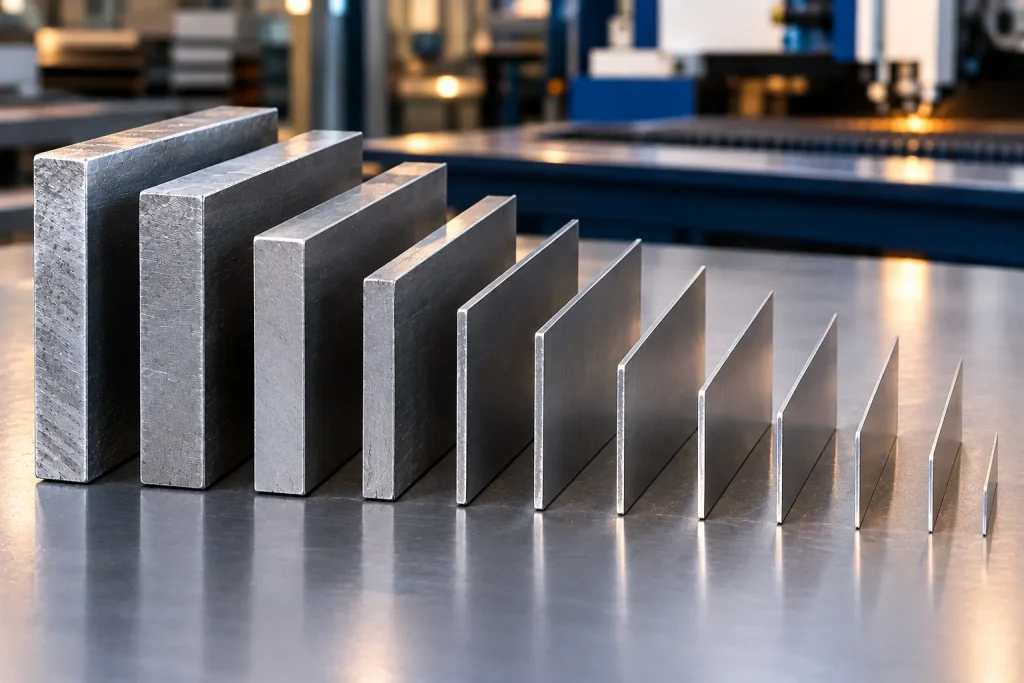 This sheet metal gauge size chart covers the most ordered gauges. Mild steel follows the Manufacturers’ Standard Gauge, stainless follows U.S. Standard, and aluminum follows Brown & Sharpe. If you work in metric, treat the steel and stainless columns as your steel gauge thickness chart in mm.
| Gauge | Mild Steel | Stainless Steel | Galvanized Steel | Aluminum |
|---|---|---|---|---|
| 7 | 0.1793″ (4.55 mm) | 0.1875″ (4.76 mm) | – | 0.1443″ (3.67 mm) |
| 8 | 0.1644″ (4.18 mm) | 0.1719″ (4.37 mm) | 0.1681″ (4.27 mm) | 0.1285″ (3.26 mm) |
| 10 | 0.1345″ (3.42 mm) | 0.1406″ (3.57 mm) | 0.1382″ (3.51 mm) | 0.1019″ (2.59 mm) |
| 11 | 0.1196″ (3.04 mm) | 0.1250″ (3.18 mm) | 0.1233″ (3.13 mm) | 0.0907″ (2.30 mm) |
| 12 | 0.1046″ (2.66 mm) | 0.1094″ (2.78 mm) | 0.1084″ (2.75 mm) | 0.0808″ (2.05 mm) |
| 14 | 0.0747″ (1.90 mm) | 0.0781″ (1.98 mm) | 0.0785″ (1.99 mm) | 0.0641″ (1.63 mm) |
| 16 | 0.0598″ (1.52 mm) | 0.0625″ (1.59 mm) | 0.0635″ (1.61 mm) | 0.0508″ (1.29 mm) |
| 18 | 0.0478″ (1.21 mm) | 0.0500″ (1.27 mm) | 0.0516″ (1.31 mm) | 0.0403″ (1.02 mm) |
| 20 | 0.0359″ (0.91 mm) | 0.0375″ (0.95 mm) | 0.0396″ (1.01 mm) | 0.0320″ (0.81 mm) |
| 22 | 0.0299″ (0.76 mm) | 0.0313″ (0.79 mm) | 0.0336″ (0.85 mm) | 0.0253″ (0.64 mm) |
| 24 | 0.0239″ (0.61 mm) | 0.0250″ (0.64 mm) | 0.0276″ (0.70 mm) | 0.0201″ (0.51 mm) |
| 26 | 0.0179″ (0.45 mm) | 0.0188″ (0.48 mm) | 0.0217″ (0.55 mm) | 0.0159″ (0.40 mm) |
| 28 | 0.0149″ (0.38 mm) | 0.0156″ (0.40 mm) | 0.0187″ (0.47 mm) | 0.0126″ (0.32 mm) |
Values are nominal. Actual thickness varies within mill tolerance.
Aluminum Gauge Thickness Chart: Why It Runs Thinner
Look at the last column above. That is the aluminum gauge thickness chart, and it runs noticeably thinner than steel at every gauge. 14 gauge aluminum is 1.63 mm, while 14 gauge steel is 1.90 mm. Swap one for the other and the part is about 14% thinner than designed. At 10 gauge, the gap grows to about 24%.
Silver Sheet Gauge Thickness Chart
Silver and gold sheet are sold by Brown & Sharpe (B&S) gauge, the same system as aluminum. This silver sheet gauge thickness chart is a reference for jewellers and metalsmiths. We fabricate steel, stainless and aluminum, not jewellery stock, so check your supplier’s listing for exact figures.
| B&S Gauge | Inches | mm |
|---|---|---|
| 16 | 0.051″ | 1.29 |
| 18 | 0.040″ | 1.02 |
| 20 | 0.032″ | 0.81 |
| 22 | 0.025″ | 0.64 |
| 24 | 0.020″ | 0.51 |
| 26 | 0.016″ | 0.40 |
| 28 | 0.013″ | 0.32 |
| 30 | 0.010″ | 0.25 |
Sheet Metal mm to Gauge Conversion Chart
Most charts only run gauge → thickness. If your drawing is in millimeters, use this sheet metal gauge conversion table to find the closest match.
| Thickness (mm) | Closest Mild Steel Gauge | Closest Aluminum Gauge |
|---|---|---|
| 0.5 | 25 | 24 |
| 0.8 | 21 | 20 |
| 1.0 | 19 | 18 |
| 1.2 | 18 | 17 |
| 1.5 | 16 | 15 |
| 2.0 | 14 | 12 |
| 2.5 | 12 | 10 |
| 3.0 | 11 | 9 |
| 4.0 | 8 | 6 |
| 5.0 | 6 | 4 |
| 6.0 | 3 | 3 |
These are closest matches, not exact ones. 2 mm, for example, is a bit thicker than 14 gauge steel (1.90 mm). If your design is metric, specify the millimeter value and skip the conversion.
Which Sheet Metal Gauge Should You Use?
These are typical starting points. Your load, material and process decide the final call.
- 10–12 gauge (2.7–3.4 mm): brackets, frames, machine bases
- 14–18 gauge (1.2–1.9 mm): enclosures, cabinets, chassis
- 16–20 gauge (0.9–1.5 mm): electrical boxes and covers
- 22–26 gauge (0.5–0.8 mm): ducting, flashing, light covers
Thickness also drives weight. A square foot of 10 gauge steel weighs about 5.49 lb, while 14 gauge weighs about 3.05 lb.
Thickness shapes cost and process, too. Laser cutting runs slower as material gets thicker, which is one reason price climbs (see our laser cutting pricing guide). Heavier gauges also need more tonnage and larger bend radii, which we cover in our press brake forming guide. And remember that the gauge you choose sets the thickness tolerance your part can hold, as explained in our sheet metal tolerance guide.
4 Gauge Mistakes That Cost Buyers Time and Money
- Using the wrong chart. 10 gauge stainless and 10 gauge aluminum differ by about 0.04″, which is well outside most tolerances.
- Mixing sheet and tube. Tubing wall gauges often differ from sheet. A 14 gauge square tube can have a 0.083″ wall, versus 0.0747″ for 14 gauge sheet.
- Forgetting the coating. Galvanized steel is slightly thicker than bare steel at the same gauge.
- Skipping the print note. A print that says “14 gauge” with no material is the kind of gap fabricators query before quoting. Add the material and the decimal thickness.
Need Parts Cut or Formed to Gauge in Ohio?
RiAlto Manufacturing has been cutting, forming, welding and machining metal in Marion, Ohio since 1981. Our 71,000-square-foot, ISO 9001-certified facility handles laser cutting, press brake forming, welding and CNC machining under one roof, so a gauge call-out on your print becomes a finished part without handoffs. Send us your drawing and we’ll confirm material and thickness before we quote. Request a quote.
Frequently Asked Questions
What is the gauge chart for sheet metal?
A sheet metal gauge chart is a lookup table that converts a gauge number into thickness in inches and millimeters. Each metal has its own column because the same gauge differs by material. For example, 16 gauge is 0.0598″ (1.52 mm) in mild steel but 0.0508″ (1.29 mm) in aluminium.
Which is thicker, 14 gauge or 16 gauge sheet metal?
14 gauge is thicker. In mild steel it measures 0.0747″ (1.90 mm) versus 0.0598″ (1.52 mm) for 16 gauge, about 0.015″ more. In every metal, the lower the gauge number, the thicker the sheet.
How thick is 12 gauge steel?
12 gauge mild steel is 0.1046″, or 2.66 mm. Stainless is slightly thicker at 0.1094″ (2.78 mm), and 12 gauge aluminum is thinner at 0.0808″ (2.05 mm).
Which is thicker, 18 or 20 gauge sheet metal?
18 gauge is thicker. Mild steel 18 gauge is 0.0478″ (1.21 mm) and 20 gauge is 0.0359″ (0.91 mm). That 0.012″ difference is enough to change how a part bends and welds.
What gauge is 1/4 inch steel?
There is no standard sheet gauge for exactly ¼″ (0.250″). The thickest common steel gauge, 3 gauge, is 0.2391″. Metal at ¼″ and above is generally called plate and is ordered by decimal or fraction instead of gauge.
Is 16 gauge always the same thickness?
No. 16 gauge is 0.0598″ in mild steel, 0.0625″ in stainless, 0.0635″ in galvanized, and 0.0508″ in aluminum. Always confirm the material, and specify thickness in inches or mm when precision matters.
What is 16 gauge steel in mm?
16 gauge mild steel is 1.52 mm (0.0598″). Stainless 16 gauge is 1.59 mm, and galvanized is 1.61 mm.
Is a higher gauge number thicker or thinner?
Thinner. The system comes from wire drawing, where each pass made the wire thinner and raised the number. So 10 gauge is much thicker than 24 gauge.
How do you convert sheet metal gauge to mm?
Find the gauge in the row for your specific metal, then read the mm column. For mild steel, 14 gauge is 1.90 mm and 11 gauge is 3.04 mm. For the reverse, use the mm-to-gauge table above and choose the closest match.
Conclusion
Choosing the right sheet metal gauge starts with identifying the material and confirming its actual thickness in inches or millimeters. Gauge numbers are useful for quick reference, but they should not replace a precise thickness specification on your drawing or order. Once the material, thickness, and required tolerances are clear, you can select the right fabrication process and avoid costly mistakes during cutting, bending, and forming. It is also important to consider safe handling and fabrication procedures when working with sheet metal. For additional guidance, see these sheet metal safety practices from OSHA.