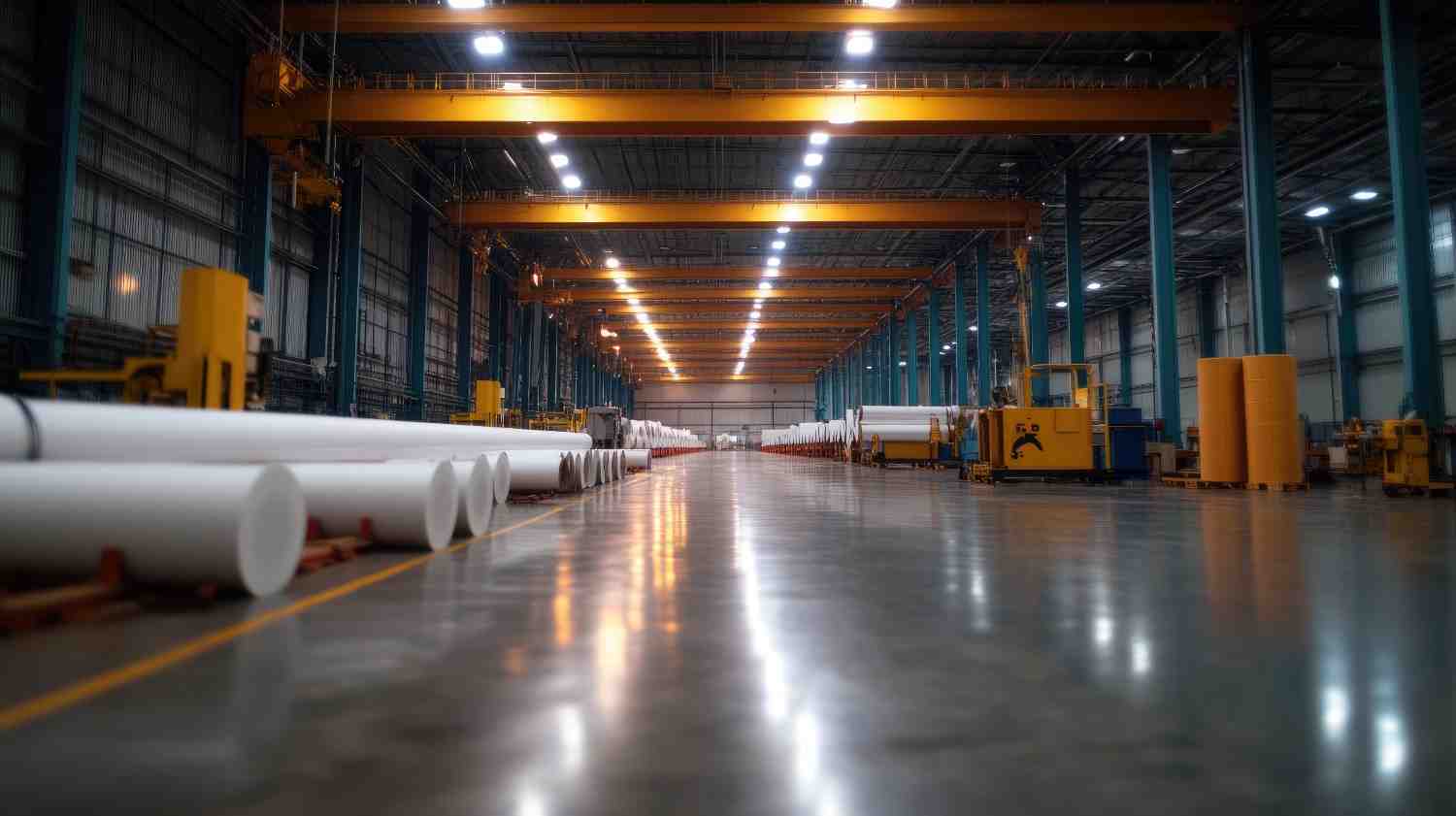
If you’ve ever wondered how a solid block of aluminium turns into a perfectly shaped automotive bracket, or how a stainless-steel rod becomes a medical implant accurate to a fraction of a millimetre, the answer is CNC machining. In simple terms, CNC machining is a computer-controlled manufacturing process that cuts, shapes, and finishes raw material into a precise part with no hand-cranked wheel, no guesswork, and virtually no room for human error. A CNC machine does this by following a digital program that tells cutting tools exactly where to move, how fast to spin, and how deep to cut.
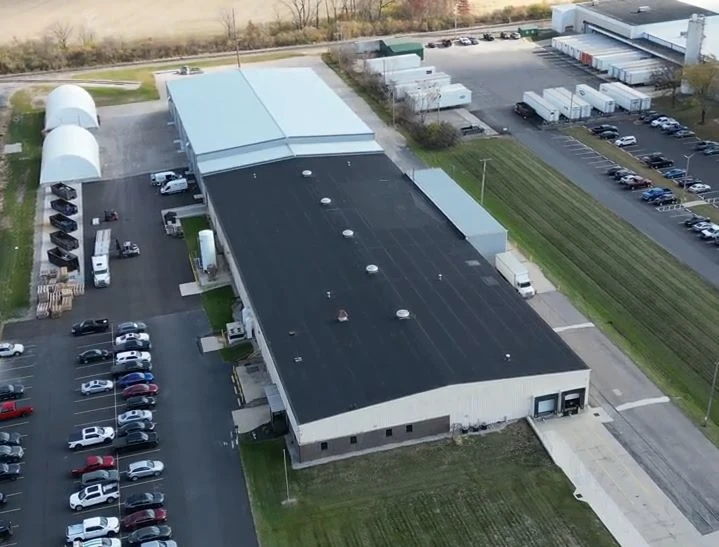
Whether you’re an engineer sourcing a metal CNC machine shop for a new product, a student researching manufacturing careers, or a business owner comparing CNC fabricators for an upcoming project, this guide walks through exactly what CNC machining is, how the process works step-by-step, and the different types of CNC machines and operations. The explanations below reflect what our CNC programmers and machinists at RiAlto Manufacturing’s Marion, Ohio, shop floor see working and failing on real production jobs every day, not just textbook theory.
What Is CNC Machining?
CNC stands for Computer Numerical Control. CNC machining is a subtractive manufacturing method, meaning it removes material rather than adding it (as 3D printing does) to shape a workpiece into a final part. A design engineer creates a 3D model in CAD (computer-aided design) software; that model is converted into machine-readable code using CAM (computer-aided manufacturing) software, and the resulting program, typically G-code tells the CNC machine’s motors exactly how to move cutting tools along the X, Y, and Z axes (and additional rotational axes on 4- and 5-axis machines) to produce anything from a single precision part to custom-built machinery for manufacturing, including purpose-built equipment for moving and handling materials on a production floor.
Unlike manual machining, where a skilled machinist physically operates levers, wheels, and dials, a CNC machine executes the entire toolpath automatically once the program is loaded and the workpiece is set up. This is why CNC machining is the backbone of modern precision manufacturing: it combines a machinist’s expertise in programming and setup with a computer’s consistency in execution.
Key entities and terms you’ll come across:
- CAD (Computer-Aided Design): Software used to create the 2D/3D digital model of the part.
- CAM (Computer-Aided Manufacturing): Software that converts the CAD model into toolpaths and G-code.
- G-code/M-code: The programming language that controls tool movement, spindle speed, coolant, and tool changes.
- Workpiece: The raw block, bar, or sheet of material being machined.
- Tolerance: The allowable dimensional variation from the design spec (often ±0.001″–±0.005″ in precision work).
- Subtractive manufacturing: Shaping a part by removing material, as opposed to additive manufacturing (3D printing).
How Does CNC Machining Work? (Step-by-Step Process)
CNC machining follows a consistent workflow whether you’re producing one prototype or ten thousand production parts.
- Design the part in CAD: An engineer builds a precise 2D or 3D digital model, defining dimensions, tolerances, and material.
- Convert the design to CAM toolpaths: CAM software analyses the model and generates the tool movements, cutting sequences, feeds, and speeds needed to produce the part.
- Generate the G-code program: The CAM software outputs G-code (and M-code), the numeric instruction set the CNC controller reads.
- Set up the machine: A machinist loads the correct cutting tools, secures the raw workpiece in a vice or fixture, sets work offsets, and confirms tool lengths. This setup stage is where real-world experience matters most, since even a small alignment error can scrap an entire batch.
- Run the program: The CNC machine executes the code automatically; the spindle rotates, cutting tools move along programmed axes, and coolant flows to manage heat and chip evacuation.
- Inspect and quality-check: Finished parts are measured against the CAD tolerances using callipers, micrometres, or coordinate measuring machines (CMM) to confirm dimensional accuracy.
- Finish and deliver: Parts may go through deburring, anodising, powder coating, or assembly before shipment.
This entire sequence from digital design to engineering support and a delivered metal part is what makes CNC machining faster, more repeatable, and far more accurate than manual methods.
Types of CNC Machines and CNC Machining Processes
Not all CNC machines do the same job. Below is a breakdown of the most common processes you’ll encounter when working with a metal CNC machine shop. If you’d like a deeper look at how each machine type is built and where it fits on a shop floor, we’ve broken it down separately in our guide to the different CNC equipment used in modern fabrication.
| CNC Process | How It Works | Best For | Typical Materials |
| CNC Milling | Rotating multi-point cutting tools remove material from a stationary or moving workpiece | Complex geometries, pockets, slots, holes, flat and contoured surfaces | Aluminium, steel, stainless steel, plasticsp[ |
| CNC Turning (Lathe) | The workpiece rotates against a stationary single-point cutting tool | Cylindrical, round, or conical parts like shafts and pins | Steel, brass, aluminium, titanium |
| CNC Drilling | A rotating drill bit bores precise round holes | Hole patterns, fastener points, bushings | Metals, plastics, composites |
| CNC Grinding | An abrasive wheel removes small amounts of material for a fine finish | Ultra-tight tolerances and smooth surface finishes | Hardened steel, tool steel |
| CNC Laser Cutting | A focused laser beam melts or vaporises material along a programmed path | Flat sheet metal parts, intricate cutouts | Steel, stainless steel, aluminium |
| CNC Plasma Cutting | An ionized plasma arc cuts through electrically conductive metal | Thicker metal plate cutting | Steel, stainless steel, aluminium |
| EDM (Electrical Discharge Machining) | Electrical sparks erode material between an electrode and workpiece | Hardened metals and intricate internal cavities | Tool steel, carbide, hardened alloys |
5-axis CNC machining deserves a special mention: instead of moving along just three linear axes, a 5-axis machine adds two rotational axes, allowing the cutting tool to approach a part from nearly any angle in a single setup. This reduces repositioning errors and is increasingly standard for complex aerospace, medical, and automotive components. RiAlto’s shop, for example, runs 5-axis and dual-spindle HAAS CNC equipment for exactly this reason.
CNC Machining vs. Traditional Manual Machining
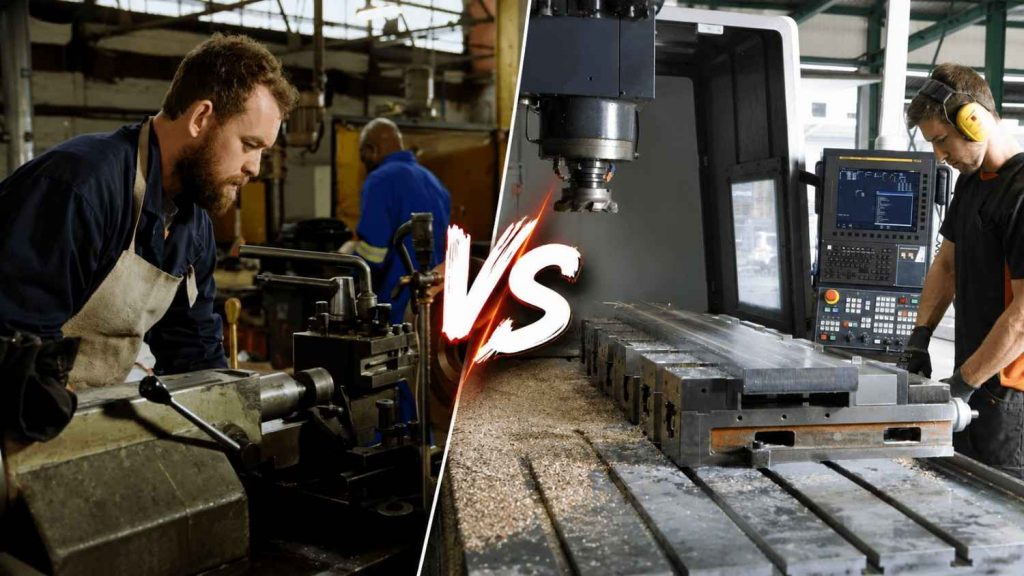
| Factor | CNC Machining | Manual Machining |
| Precision | Extremely high (±0.001″ achievable) | Dependent on operator skill |
| Repeatability | Identical parts, run after run | Varies part to part |
| Speed for volume production | Fast, continuous, automated | Slower for repeat runs |
| Setup time | Longer initial programming/setup | Faster for one-off simple jobs |
| Labour requirement | Skilled programmer + operator to monitor | Skilled machinist operating continuously |
| Best use case | Prototypes through high-volume production | Simple, low-quantity, or highly custom one-offs |
CNC Machining vs. 3D Printing
A common question buyers ask is whether to choose CNC machining or additive manufacturing (3D printing). CNC machining is subtractive (removing material) and typically produces stronger, more dimensionally accurate parts in production-grade metals, making it the standard choice for functional, load-bearing, or precision-tolerance components. 3D printing is additive (building layer by layer) and is often better suited to rapid, low-cost prototyping of complex geometries where material strength is less critical. For production metal parts, CNC machining remains the industry standard. If you’re weighing CNC machining against other early-stage options, our guide on how prototyping fits into the product development timeline covers this in more depth.
Materials Commonly Used in CNC Machining
CNC machines can work with a wide range of materials. In metal, the most common shop-floor choices are aluminium, mild steel, stainless steel, brass, copper, and titanium; in plastics, ABS, nylon, polycarbonate, acetal (Delrin), and PEEK are typical; select composites like carbon fibre are also machined for lightweight, high-strength parts.
Material choice affects cutting speed, tool wear, achievable tolerances, and overall part cost, and it’s a decision worth getting right before you finalize a design.
Industries That Rely on CNC Machining
CNC machining is used almost everywhere precision manufacturing matters, including:
- Automotive: Brackets, housings, engine components
- Agriculture: Custom equipment parts, fixtures
- Medical equipment: Implants, surgical instruments, device housings
- Food processing: Sanitary stainless-steel components
- Energy/Solar: Structural and mounting components
- Industrial equipment & appliances: Custom machine parts
- Aerospace & defence: Tight-tolerance structural and engine parts
Benefits of CNC Machining
- Precision and consistency: Parts match CAD specs within thousandths of an inch, run after run
- Speed at scale: Once programmed, CNC machines run continuously with minimal supervision
- Design flexibility: Complex geometries that are difficult or impossible to produce manually
- Reduced waste: Optimized toolpaths minimize scrap material
- Lower long-term labour cost: One operator can often oversee multiple machines simultaneously
- Material versatility: Metals, plastics, and composites can all be CNC machined
According to recent industry research, the global CNC machine market is valued in the $100–115+ billion range in 2026 and is projected to keep growing at roughly a 5–11% CAGR through the early 2030s, driven largely by automotive electrification, aerospace re-equipment, and reshoring of U.S. manufacturing. Industry data also shows over 4.6 million CNC machines operating worldwide, with more than 60% of U.S. manufacturers now outsourcing at least some precision parts to third-party CNC machining services a strong signal of how central this process has become to modern supply chains.
What to Look for in a CNC Machining Shop
Not every shop that owns a CNC machine is equipped for every job. On the machining side specifically, three capability signals matter most:
- Axis count and setup flexibility: A 3-axis mill handles simple geometry; a 5-axis or dual-spindle machine cuts complex, multi-angle parts with fewer setups, reducing repositioning errors and enabling tighter tolerances.
- Tolerance and quality documentation: For regulated industries (medical, aerospace, automotive), ask whether the shop is ISO 9001 certified and can provide inspection reports for critical dimensions.
- Material and volume range: Confirm the shop regularly runs your specific material (aluminium, stainless, titanium, engineering plastics) at your required quantity, from single prototypes through production volume.
Beyond the machining equipment itself, choosing a manufacturing partner involves a broader set of questions: track record, in-house engineering, on-time delivery, and communication protocols.
CNC Machining at RiAlto Manufacturing
On the CNC side, specifically, RiAlto runs 5-axis and dual-spindle HAAS CNC machines, which lets us shop-hold tight tolerances on complex, multi-angle parts in a single setup rather than repositioning the workpiece multiple times. That machining capability sits alongside our in-house laser cutting, welding, and engineering teams in our Marion, Ohio facility, so a part can move from CNC programming straight into finishing and assembly without leaving the building.
For the full story on our facility, certifications, and company history, see our equipment list.
Frequently Asked Questions About CNC Machining
What does CNC stand for?
CNC stands for Computer Numerical Control, a manufacturing method where computers automatically control machine tools using programmed instructions.
What is the difference between CNC machining and 3D printing?
CNC machining removes material from a solid block (subtractive), producing strong, precise parts in production-grade materials. 3D printing builds parts layer by layer (additive), which is often faster for prototyping but generally less suited for high-strength, tight-tolerance production parts.
What materials can be CNC machined?
Most metals (aluminium, steel, stainless steel, brass, titanium) and many plastics (ABS, nylon, Delrin, PEEK) can be CNC machined, along with select composites.
How accurate is CNC machining?
Standard CNC machining typically holds tolerances of ±0.005 inch, with precision applications achieving ±0.001 inch or tighter depending on the machine, tooling, and material.
What is the difference between CNC milling and CNC turning?
CNC milling uses rotating cutting tools on a stationary workpiece to create flat, contoured, or complex shapes. CNC turning rotates the workpiece against a stationary cutting tool, ideal for cylindrical parts like shafts and pins.
Is CNC machining expensive?
Cost depends on part complexity, material, tolerance requirements, and quantity. Programming and setup add upfront cost, but per-part cost drops significantly at higher volumes, making CNC machining cost-effective for both prototypes and production runs when handled by an experienced shop.
What industries use CNC machining the most?
Automotive, aerospace, medical devices, agriculture, energy, and industrial equipment manufacturing are among the top industries relying on CNC machining for precision components.
How long does CNC machining take?
Turnaround time depends on part complexity, material, and quantity; simple prototypes can be completed in days, while larger production runs are scheduled based on shop capacity and lead time.
Final Thoughts
CNC machining has become the standard for precision manufacturing because it combines engineering-level accuracy with production-level speed. Whether you need a single prototype or a long-term production partner, understanding the process, the machine types, and what to look for in a shop helps you make a confident sourcing decision. Demand for skilled CNC talent remains strong nationwide; the U.S. Bureau of Labour Statistics projects tens of thousands of machinist job openings every year, driven largely by retirements and the ongoing shift toward CNC-controlled production, a clear signal of how central CNC machining has become to modern U.S. manufacturing.
Looking for a metal CNC machine shop that delivers on time every time? RiAlto Manufacturing offers CNC machining, laser cutting, welding services, and engineering support under one roof in Marion, Ohio. Request a quote today and let our team help bring your next project to production.