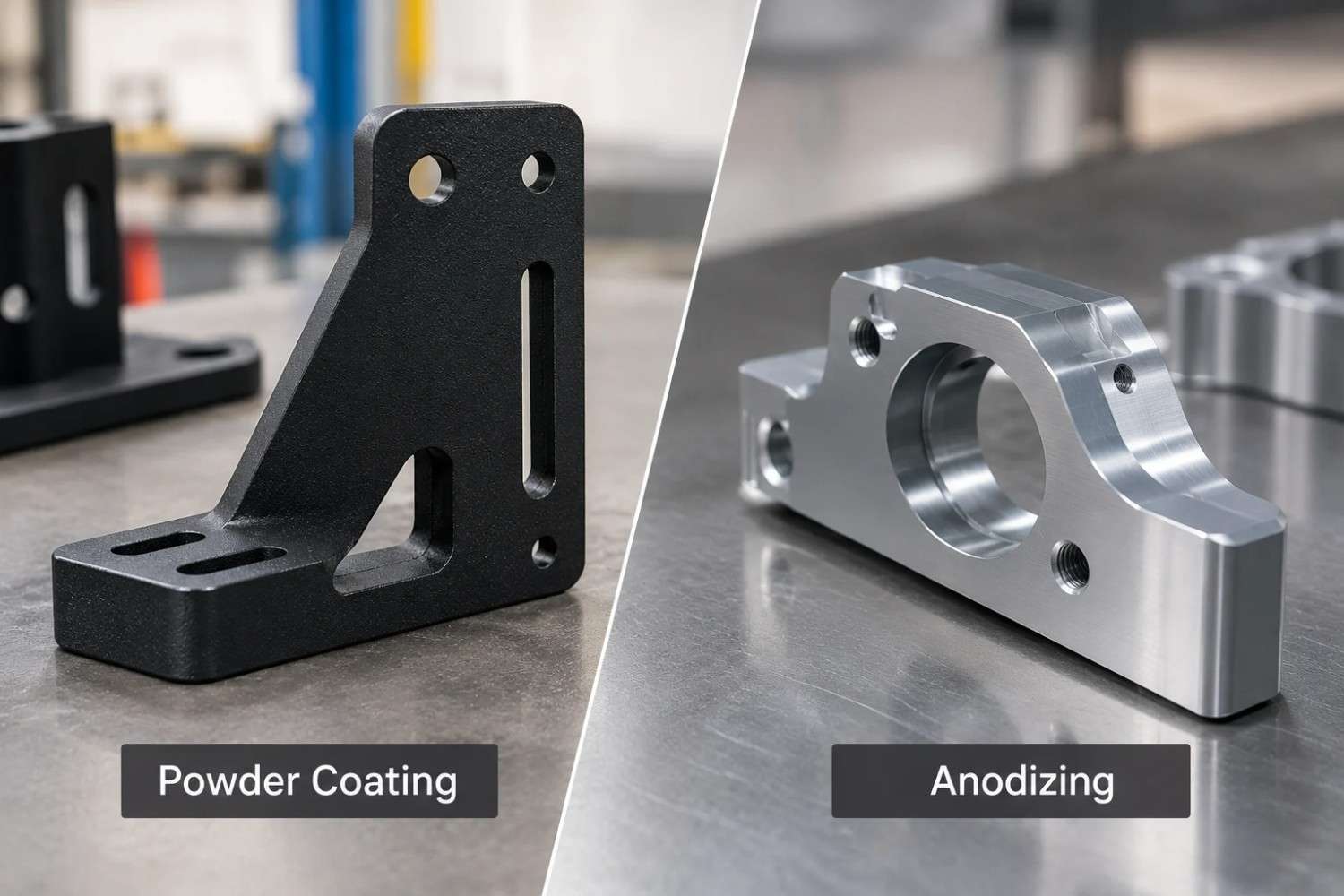
Neither finish wins every time. Choose anodizing for aluminum parts that need tight tolerances, wear resistance, and a natural metallic look. Choose powder coating for steel parts, large or welded assemblies, bold colors, impact resistance, and lower cost. If your part is steel, the choice is already made, because anodizing is not an option.
At RiAlto Manufacturing, we have cut, bent, welded, and machined metal in Marion, Ohio since 1981. Finishing is one of the seven core metal fabrication methods we plan around on almost every print. This guide answers the question the way we would at the front counter: material first, then what the part has to survive.
Powder Coating vs Anodizing at a Glance
This comparison covers what most buyers need to decide in under a minute.
|
Factor |
Powder Coating |
Anodizing |
|
What it is |
Dry polymer powder sprayed on and baked |
Electrochemical process that grows an oxide layer from the aluminum |
|
Works on |
Steel, stainless, aluminum |
Aluminum (almost exclusively) |
|
Typical thickness |
50–125 µm (0.002–0.005″) |
5–25 µm (0.0002–0.001″) |
|
Effect on dimensions |
Noticeable; threads and holes need masking |
Small, but not zero |
|
Colors |
Nearly unlimited, gloss to textured |
Limited: clear, black, bronze, some dyes |
|
Impact resistance |
Better |
Brittle; can crack |
|
Wear resistance |
Moderate |
Better, especially Type III hard coat |
|
UV stability |
Good with the right powder; can fade |
Very stable, though some dyed colors fade |
|
Typical cost |
Usually lower, especially in batches |
Usually higher, especially hard coat |
|
Repair |
Can be stripped and recoated |
Hard to touch up |
What Is the Difference Between Powder Coating and Anodizing?
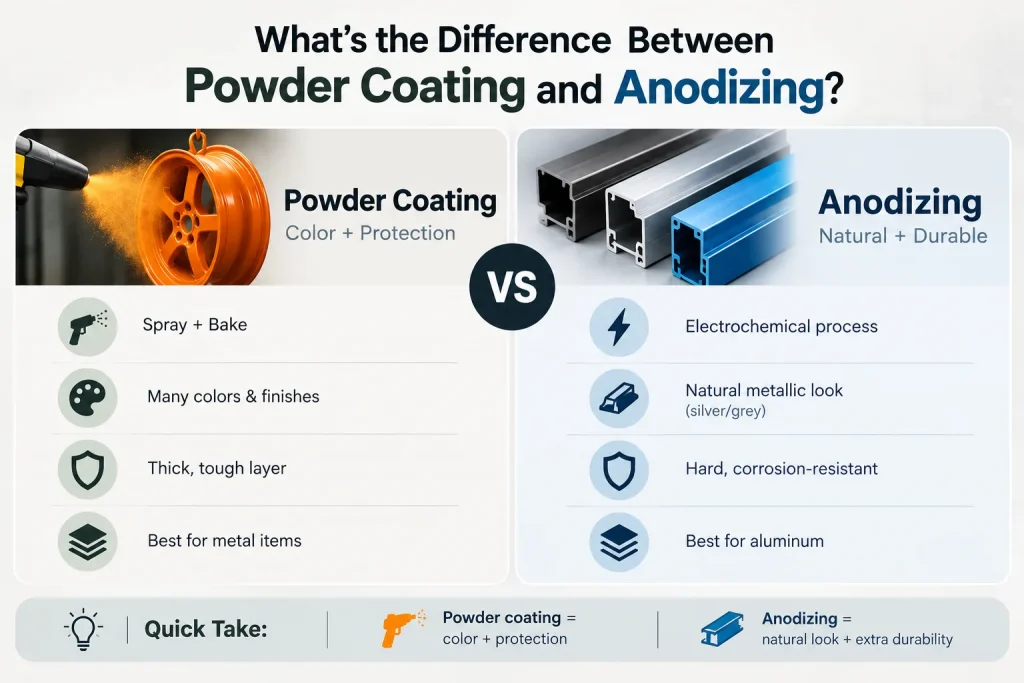
The difference between anodized and powder coated aluminum comes down to where the protection sits. Powder coating sits on top of the surface. Anodizing becomes part of the surface. Either way, it starts with a well-made part from a shop that handles metal fabrication and machining under one roof.
In powder coating, the part is cleaned and pretreated, an electrostatic gun sprays charged powder onto it, and an oven cures it at roughly 350–400°F into a continuous, paint-like skin. In anodizing, the aluminum is cleaned, submerged in an acid bath, and run on electric current so a hard aluminum oxide layer grows out of the metal itself. It can then be dyed and sealed.
Anodized Aluminum vs Powder Coated Aluminum: How They Compare
Durability and wear
Anodized aluminum is harder than powder coat, so it resists scratches and sliding wear better. The trade-off is that it is brittle: a sharp hit can crack the oxide layer. Powder coating is more flexible and absorbs impact well, but a hard strike can chip it and expose bare metal.
Corrosion and weather
Both finishes protect aluminum when intact. A properly sealed anodized layer is part of the metal, so it cannot peel. Powder coat can peel, and once it is damaged, moisture can creep underneath. For steel, powder coating is the practical choice, since steel cannot be anodized.
Appearance
Powder coating hides machining marks and weld seams under a uniform color or texture. Anodizing follows the metal underneath, so every tool mark and scratch shows. That works well on a polished CNC machined part, but not on a rough fabrication.
Tolerances
Anodizing grows roughly half its thickness into the part and half outward, so the dimensional change is small. Powder coating builds a thicker film that can shrink holes, fill threads, and make press fits too tight. Both need planning on precision parts, which is why we cover finish allowances in our guide to precision sheet metal fabrication tolerances.
Which Is Better for Your Part?
Choose anodizing when:
- The part is aluminum and has tight-fit features, precision threads, or sliding surfaces
- You want the metal to show through with a clean, technical look
- The part is a heat sink or housing that needs to shed heat
- Wear matters more than impact
Choose powder coating when:
- The part is steel, stainless steel, or a mix of metals in one assembly
- The part is large, welded, or has rough surfaces to cover
- You need a specific color, texture, or brand match
- The part will take knocks, such as frames, guards, brackets, and equipment covers
- Budget is the main constraint
What Most Guides Miss: Welds, Edges, and Ohio Weather
Welded assemblies – Anodizing exposes welds, and filler alloys often anodize to a different color than the base metal. If a fabricated aluminum part has visible welds, powder coating usually gives a cleaner result.
Cut edges – Powder tends to thin out on sharp edges, which is where chipping and early rust start on steel. Ask for broken or deburred edges on laser-cut and sheared parts before they go to finish.
Ohio conditions – Road salt and freeze-thaw cycles punish coatings from November through March. For outdoor steel, a well-pretreated powder coat is the standard answer. For outdoor aluminum, either finish can work, but use sealed anodizing or an exterior-grade polyester powder, and avoid designs that trap water.
Order of operations – Finish last, after cutting, bending, Metal welding and machining. Mark any threads, ground points, and bearing surfaces that must stay bare so they can be masked.
How to Brief Your Fabricator
A good request for quote (RFQ) prevents most finish problems. Include:
- Base material and alloy (for example, 6061 aluminum or mild steel)
- Finish type and spec (anodize Type II or Type III to MIL-A-8625, or powder color and gloss)
- Critical dimensions, threads, and surfaces to mask
- Where the part lives: indoors, outdoors, near salt, or around chemicals
- Quantity, since batch size affects finish cost
If your design mixes machined and fabricated features, flag any finish-sensitive surfaces on the print so they can be masked before cutting starts.
Have a print and an unsure finish? Send it to RiAlto for a quote and we will review the finish with the design.
Frequently Asked Questions
Is anodizing better than powder coating?
Anodizing is better for aluminum parts that need hardness, tight tolerances, and a metallic look. Powder coating is better for color range, impact resistance, steel parts, and lower cost. The better finish depends on the material and the part’s job.
Is it better to powder coat or anodize aluminum?
Anodize aluminum when fit, wear, and heat transfer matter. Powder coat it when color, hiding weld marks, or budget matter more. For precision machined aluminum, anodizing usually wins. For large painted-look fabrications, powder coating usually wins.
What is more expensive, anodizing or powder coating?
Anodizing usually costs more per part, especially hard coat or small, detailed parts. Powder coating is typically cheaper, particularly on larger parts and batches. Masking, color changes, and tight tolerances can raise the price of either one.
Which lasts longer, anodizing or powder coating?
Sealed anodizing usually lasts longer on aluminum because it is part of the metal and cannot peel. Powder coating can last many years outdoors but may chip or fade. Impact-prone parts can still favor powder coat.
Can you powder coat over anodized aluminum?
Yes, it can be done, but it is rarely recommended. Adhesion depends on surface preparation, and you lose the benefits of the anodized layer. If you want color, powder coat bare aluminum instead.
Is anodizing stronger than powder coating?
Anodizing is harder and more abrasion resistant, but it does not make the aluminum itself stronger. Powder coating handles impact better because it flexes. Neither finish adds meaningful structural strength to the part.
Which is better for outdoor use, anodizing or powder coating?
For outdoor aluminum, sealed anodizing offers stable color and no peeling, while quality exterior powder offers more color choices. For outdoor steel, powder coating is the practical option. Ohio’s road salt makes pretreatment and sealing important.
Conclusion
So, which is better powder coating or anodizing? Start with the material. Steel means powder coating. Aluminum means you weigh tolerance, wear, and look against color, impact, and cost. When in doubt, send us the print and the team at RiAlto Manufacturing in Marion, Ohio will help you pick before the part is built.