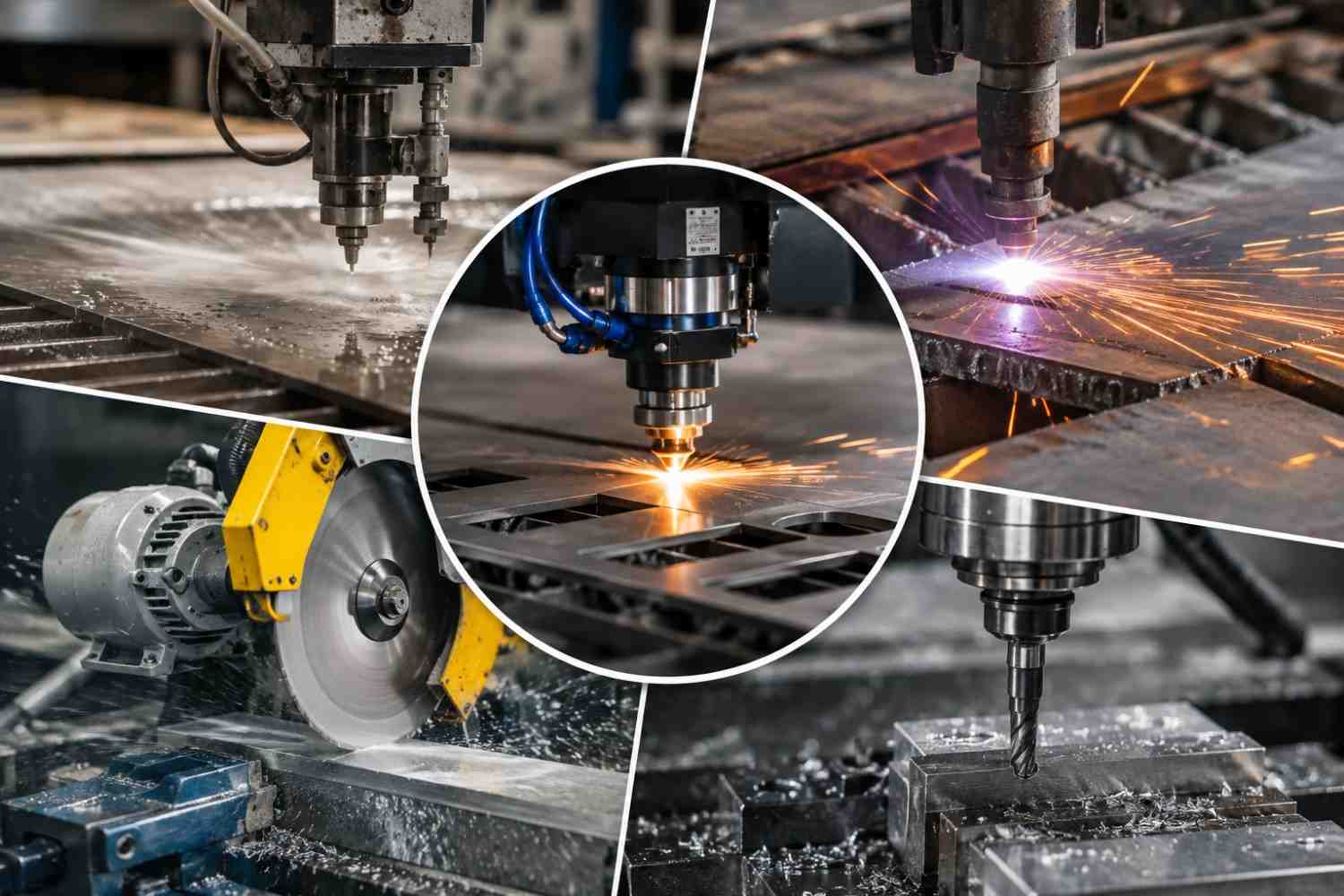
If you’ve ever sent a print to a fabricator, you may have gotten back a question. Something like “laser or waterjet?” or “weld it or bolt it?” This guide is for you. There are 7 common metal fabrication methods: cutting, bending (forming), welding, machining, casting, stamping, and finishing/assembly. Nearly every metal part on the market is built using some combination of these processes. That includes a bracket on a farm implement and a housing on a data center rack. Knowing what each one does helps in a few ways. You can talk to your supplier with confidence. You can choose the right metal fabrication techniques for your part. And you can get a project quoted before a redesign eats your budget.
At RiAlto Manufacturing, we’ve been running these exact processes under one roof in Marion, Ohio since 1981. So this isn’t theory. It’s what our floor does every day for customers across agriculture, automotive, energy, and industrial equipment.
1. Cutting
Cutting is almost always the first step in any metal fabrication workflow it turns raw sheet, plate, or bar stock into a workable blank. Modern shops use our laser cutting process for speed and precision on thinner gauges, plasma cutting for thicker mild steel on a budget, and waterjet cutting when heat-sensitive materials or extra-thick plate are involved. Sawing still has its place for simple straight cuts on bar and tube stock. If you’re weighing lasers against older technology, this fibre vs. CO2 breakdown explains why most shops have already switched.
Best for: Nearly every job starts here, regardless of final part complexity.
2. Bending and Forming
Once metal is cut to size, it often needs shape. Our press brake equipment uses a punch and die to bend flat sheet or plate into angles, channels, and boxes without removing any material. Roll forming and rotary draw bending handle tube and bar stock for curved or cylindrical parts. Bend sequence and tooling matter; get them wrong, and tight-tolerance assemblies won’t fit. For a deeper walkthrough of tonnage, dies, and bend allowances, our press brake forming guide covers the engineering side in detail.
Best for: Brackets, enclosures, chassis, and any part that needs an angle instead of a weld.
3. Welding
Welding joins two or more metal pieces using heat, pressure, or both. MIG welding is fast and cost-effective for production runs; TIG welding produces cleaner, more precise welds for thinner materials or cosmetic joints; stick (SMAW) welding still shows up in heavy structural and field work. Welding is usually the step that turns individual formed and cut pieces into one finished weldment, which is exactly what our welding team handles once parts come off the press brake.
Best for: Structural frames, assemblies, and parts too complex to machine or cast from a single blank.
4. Machining
Machining is a subtractive process material is removed from a solid block or blank until the finished geometry remains. CNC machining (milling and turning) is the modern standard because a digital program controls tool path, speed, and depth, holding tolerances that manual machining can’t match consistently. If you’re not sure whether your part needs a mill, a lathe, or something more specialized, this guide to the five machine types breaks down which one fits which job. This is one of the steel fabrication methods used most often for tight-tolerance parts, mating surfaces, and threaded features, and it’s a core part of our in-house machining capacity.
Best for: Precision components, prototypes, and parts with tolerances tighter than ±0.005″.
5. Casting
Casting pours molten metal into a mold and lets it solidify into the desired shape. Sand casting is slower but affordable and good for complex geometries; die casting suits high-volume runs. Casting is one of the oldest metal processing techniques and remains the most economical way to produce complex shapes in large quantities, though it usually needs secondary machining for tight-tolerance features the same finishing standards we cover in our sheet metal tolerance guide.
Best for: High-volume parts with complex internal geometry, like housings and manifolds.
6. Stamping and Punching
Stamping presses sheet metal between dies to cut, form, or emboss it in a single stroke think automotive body panels or repeated hole patterns. Punching does the same on a smaller scale, often on a turret punch, to add holes, slots, or louvers to a flat sheet before it’s bent or welded. These are among the fastest sheet metal manufacturing methods for repeat production, and they often feed straight into our press brake and welding lines for the next step.
Best for: High-volume sheet metal parts with repeating features.
7. Finishing and Assembly
The last step covers deburring, sanding, powder coating, plating, and final assembly. Finishing protects against corrosion, meets cosmetic specs, and prepares a part for its end use, while assembly (welding, riveting, or fastening) turns individual components into a complete product ready to ship a step you can see in our assembly line fixture builds.
Best for: Every job this is what separates a “part” from a finished, ready-to-install product.
How to Choose the Right Metal Processing Method
Match the process to these four factors:
- Material and thickness: A Thin sheet favors laser cutting and press brake work; thick plate favors plasma or waterjet.
- Tolerance requirements: Anything under ±0.005″ typically needs CNC machining, not forming or casting alone.
- Production volume: One-off prototypes favor cutting and machining; thousands of identical parts favor stamping or casting.
- Budget and lead time: Combining processes (cut, form, weld) in one shop usually beats outsourcing each step separately.
If your project is still early-stage, looping in our engineering team before you lock a design can save a second round of tooling costs.
Why Ohio Manufacturers Choose a Local, One-Stop Fabricator
Ohio’s manufacturing base agriculture, automotive, energy, and industrial equipment runs on tight production schedules, and shipping half-finished parts between three different vendors adds weeks to a project. RiAlto Manufacturing operates a 71,000-square-foot, ISO 9001–certified facility in Marion, Ohio, where laser cutting, press brake forming, CNC machining, and welding happen under one roof, with one point of contact from quote to delivery. Browse our full range of services to see everything handled in-house.
Frequently Asked Questions
What are the different methods of metal fabrication?
The main methods are cutting, bending/forming, welding, machining, casting, stamping/punching, and finishing/assembly. Most finished parts combine several of these in sequence.
What is the most common metal fabrication process?
Cutting is the most universally used step, since nearly every part starts as a cut piece of raw material before any other process is applied. To see how much that first step typically costs, our laser cutting pricing guide breaks it down by material and thickness.
What is the difference between metal fabrication and machining?
Fabrication typically covers cutting, forming, and joining sheet or structural metal. Machining works differently; it’s a subtractive process that removes material from a solid block to reach a precise final shape.
What is the cheapest way to fabricate metal?
For simple shapes and higher volumes, stamping and plasma cutting tend to be the most cost-effective. For one-off or low-volume parts, laser cutting and CNC machining often win instead, since tooling costs get factored into the total price. If you’re deciding between two thermal cutting methods, our plasma vs. waterjet comparison walks through the cost and tolerance trade-offs.
What metal is easiest to fabricate?
Mild steel and aluminum are the easiest metals to cut, bend, and weld. They’re also the most economical. That’s why they’re the default choice for most industrial fabrication projects.
Ready to talk through your part? Get your project quoted by RiAlto Manufacturing and get cutting, forming, welding, and machining handled under one roof.
References
- Metal Fabrication, Wikipedia: A general overview of what metal fabrication covers, how it differs from machining and casting, and the core cutting, forming, welding, and finishing processes used in a typical fab shop.
- Welding, Cutting, and Brazing, OSHA: The federal safety standards that apply to welding and cutting operations, useful for anyone who wants to understand the workplace hazards and precautions behind this method.
- Machinists and Tool and Die Makers, U.S. Bureau of Labor Statistics: Official government data on what machinists do day-to-day, the training path into the trade, and current job outlook, which puts the machining section in real-world context.