What is deburring? Deburring is the process of removing burrs, the small raised edges, sharp ridges, or loose bits of material left on a part after cutting, drilling, stamping, bending, or machining. It makes parts safe to handle, helps them fit and assemble correctly, and prepares edges for welding or coating.
RiAlto Manufacturing has run laser cutting, press brake forming, welding, and CNC machining under one roof in Marion, Ohio, since 1981. This guide explains deburring the way we explain it to customers: what it is, which method fits which part, and how to call it out on your drawing so you get the edge you expect.
What Does Deburr Mean, and What Is a Burr?
Deburring a part means removing its burrs. A burr is unwanted material that stays attached to a workpiece after a cutting or forming operation. It forms when metal is pushed, torn, or sheared instead of separating cleanly, which is why even parts from precision laser cutting for custom metal parts still need an edge check.
Four burr types show up most often:
- Rollover burrs: material that folds over the edge as the cut exits. Common after laser cutting, punching, and milling.
- Poisson burrs: displaced material that bulges sideways at the end of a cut.
- Tear burrs: ragged edges left when ductile metal tears, typical in stamping and shearing.
- Cut-off burrs: a small nub left where a part separates from bar stock.
Why Deburring Matters
Skipping it causes problems that usually show up at the worst time:
- Safety: sharp edges cut hands during handling and assembly.
- Fit: a burr under a fastener or on a mating surface keeps parts from seating.
- Coating quality: paint and powder coat thin out over sharp edges and chip there first.
- Strength: burrs can act as stress points and shorten fatigue life.
- Appearance: rough edges are the first thing a customer notices.
What Is the Deburring Process?
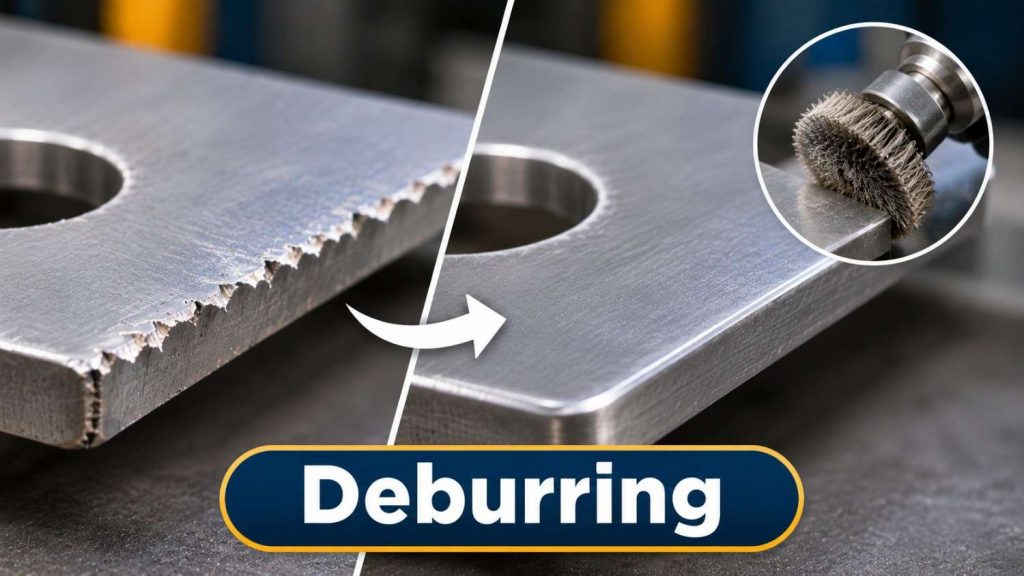
The deburring process is simple in concept, but good shops treat it as a controlled step, not an afterthought.
- Find the burrs: Check cut edges, hole exits, and bend lines.
- Choose a method: Match it to the material, burr size, part shape, and volume.
- Remove the burr: Work without gouging the part or changing critical dimensions.
- Clean the part: Chips and fine debris can leave secondary burrs behind.
- Inspect: Check by sight, by touch, or under magnification against the drawing requirement, the same way we verify tolerances in precision sheet metal fabrication.
What Is Deburring Metal? Common Methods Compared
Deburring metal can be done several ways, and the right one depends on the part, not on which method sounds most advanced.
|
Method |
Best for |
Watch out for |
|
Manual (files, scrapers, hand tools) |
Prototypes, one-offs, small runs |
Slow; results vary by operator |
|
Brush deburring |
Light burrs, surface cleanup |
Large burrs, very hard metals |
|
Belt or disc machine |
Flat laser-cut or punched sheet parts |
Small or heavily formed parts |
|
Vibratory tumbling |
Many small parts at once |
Cycle time; media must suit the alloy |
|
CNC deburring tools |
Machined parts, repeatable edges |
Hard-to-reach areas |
|
Thermal (TEM) |
Internal cross-holes, complex parts |
Chamber size limits part size |
|
Electrochemical |
Precision internal edges |
Setup cost; parts need cleaning |
|
Waterjet or robotic |
High-volume repeat parts |
Equipment investment |
What Is a Deburring Tool Used For?
A deburring tool is a blade, cutter, abrasive, or brush that shaves or scrapes burrs off an edge or hole. So what does a deburring tool do? It removes the raised lip and, in most cases, leaves a slight edge break so the corner is no longer sharp.
Common tools and the jobs they handle:
- Hand deburring tools with swivel blades: straight edges and the entry and exit of drilled holes.
- Files and scrapers: flat edges and outside corners.
- Countersink and chamfer tools: hole edges, often run right inside the machine during 5-axis and dual spindle CNC machining.
- Rotary files and abrasive wheels: harder-to-reach spots with a power tool.
- Abrasive brushes: light burrs and final cleanup.
In practice, deburring tools are used for two things: making edges safe and making parts fit.
What Is a Deburring Machine?
A deburring machine removes burrs automatically instead of by hand. Most use brushes, abrasive belts, or discs, and others tumble parts in abrasive media. They make sense when volume is high, because they deliver consistent edges and free skilled workers for other tasks. For flat laser-cut sheet metal, belt-and-brush machines can finish a part in one pass.
How to Specify Deburring on Your Drawing
Most guides stop at methods. The more common problem is that nobody defined “burr-free.” A drawing that only says “deburr” leaves the quality call to whoever is holding the part. To avoid that:
- Add a general note such as “break all sharp edges,” with a size limit (for example, 0.005 to 0.015 in.).
- Call out critical edges separately: sealing surfaces, cosmetic edges, and hole edges.
- State whether edges should be radiused, chamfered, or simply burr-free.
- Reference ISO 13715 if your company uses it to define edge conditions on drawings.
Clear callouts prevent rework and keep quotes accurate, because the shop prices the edge you actually want. Designing edges and holes correctly from the start helps too, and our sheet metal design rules that prevent rejected parts explain how.
Should You Deburr Before or After Forming and Coating?
In most cases, deburr after cutting and before bending, welding, or coating. Edges are easier to reach on a flat part, and burrs left under a coating cause chipping. Some welded assemblies need a light second pass afterward. If your part is headed for finishing, see our comparison of powder coating vs. anodizing.
Deburring Safety Basics
Wear safety glasses and cut-resistant gloves for hand work. Keep gloves and loose sleeves away from rotating brushes, wheels, and spindles. Clamp small parts rather than holding them, because hand tools slip.
Looking for Deburring in Ohio?
If you’re searching for deburring near Columbus, Mansfield, or anywhere in Central Ohio, ask any shop four questions: Is deburring included in the quote? How do you define burr-free? Do you inspect edges before shipping? Can you cut, form, weld, and deburr in one place? That last one matters, because every handoff between vendors adds lead time and risk.
RiAlto handles burr removal as part of laser cutting, press brake forming, welding, and CNC machining at our Marion facility, and we ship across the U.S. Request a quote and tell us the edge condition you need.
Frequently Asked Questions
What is the purpose of deburring?
The purpose of deburring is to remove sharp, raised edges so parts are safe to handle, fit together properly, and hold coatings well. It also removes stress points that can shorten a part’s life.
What is deburring in machining?
In machining, deburring is the finishing step that removes burrs left by milling, turning, drilling, or cutting. It is done with hand tools, CNC deburring tools, brushes, or tumbling, depending on the part.
What is the difference between deburring and chamfering?
Deburring removes the burr. Chamfering cuts a deliberate angled edge, usually 45 degrees. A chamfer can remove a burr as part of the cut, but basic deburring does not create a defined angle.
What is a deburring tool used for?
A deburring tool removes burrs from edges and drilled holes after cutting or machining. Hand versions use a swivel blade, and machine-mounted versions use chamfer cutters or abrasives.
What is the best way to deburr metal?
It depends on volume and part shape. Hand tools suit prototypes, belt or brush machines suit flat sheet parts, and tumbling suits many small parts. Hard-to-reach internal burrs may need thermal or electrochemical methods.
Is deburring necessary?
For most metal parts, yes. Burrs are a cut hazard, can stop parts from seating, and can ruin a coating. Only hidden, non-functional edges may be left as-is, and only if the drawing allows it.