Industrial laser cutting is a thermal fabrication process that uses a concentrated, computer-controlled beam of light to melt, burn, or vaporize material along a programmed path. Because it’s a completely non-contact process, there’s zero physical tool pressure, which means exceptional accuracy without material distortion or blade wear.
But how does a beam of light generate enough energy to slice through solid metal in seconds, and how does a digital CAD file turn into a finished, dimensionally accurate part? This guide breaks down the entire industrial laser cutting process, from beam generation to final part quality, so you understand exactly what happens inside the machine and why it has become the manufacturing standard for precision metal cutting.
But how exactly does a beam of light achieve enough power to slice through heavy metal instantly, and how does it translate a digital drawing into a flawless physical part?
Understanding how industrial laser cutting works starts with recognizing why the technology has become a manufacturing standard. It combines speed, precision, and design flexibility in ways that traditional cutting methods cannot match. This overview breaks down the process step by step, from beam generation to final part quality.
What Is Industrial Laser Cutting?
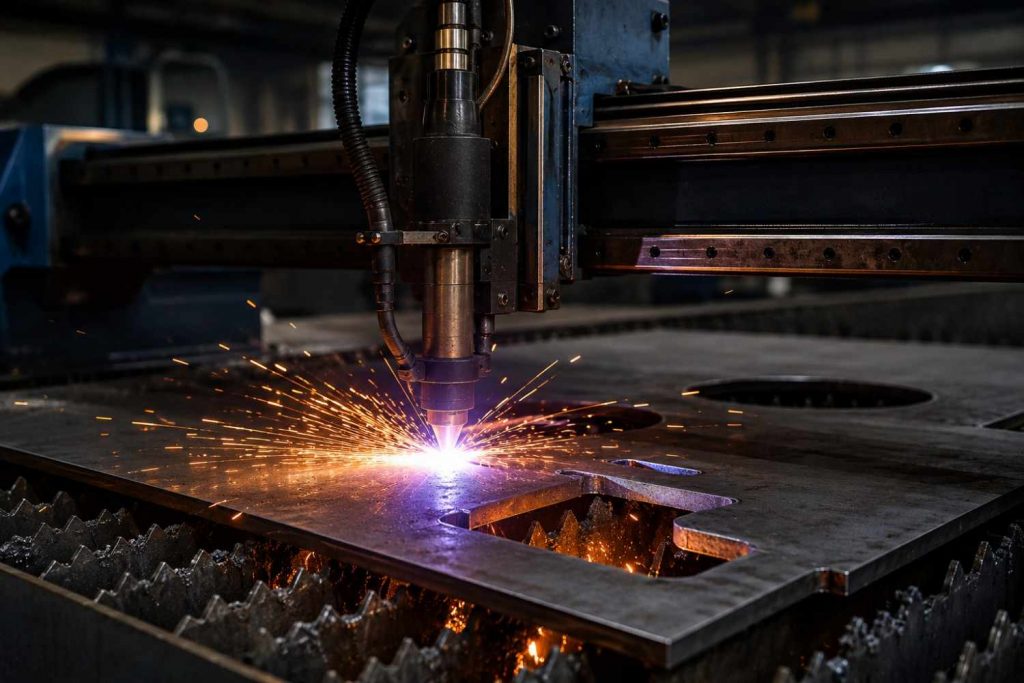
Industrial laser cutting is a thermal separation process that uses a highly focused beam of light to melt, burn, or vaporise material along a precise, CNC-programmed path. At RiAlto Manufacturing, this precision comes through in our full precision cutting capabilities, where every cut relies on this same non-contact approach. Unlike mechanical cutting methods such as sawing or shearing, laser cutting is non-contact; the material never experiences physical tool pressure, so there’s no blade wear and dramatically less distortion.
This distinction is the reason laser cutting has become central to modern manufacturing: it holds tight tolerances consistently, run after run, without the mechanical variables that affect traditional cutting tools.
How Does Laser Cutting Work? The Process Step by Step
The laser cutting process steps follow a repeatable sequence every time, regardless of the part being produced:
- Beam generation: A laser source generates and amplifies a concentrated beam of light.
- Beam focusing: Mirrors and lenses direct and focus the beam down to a precise point through the cutting head.
- Material interaction: The focused beam strikes the material surface, rapidly heating it until it melts, burns, or vaporizes.
- Assist gas clearing: A jet of gas (oxygen, nitrogen, or compressed air, depending on the material) blows the molten material out of the cut, keeping the kerf clean.
- CNC-guided motion: The cutting head follows a pre-programmed CNC path, tracing the exact part geometry from the CAD file.
- Part completion: The process repeats along the entire toolpath until the part separates cleanly from the sheet.
Each step depends on the one before it, which is why consistency at the beam source directly determines the quality of the final cut.
Laser Beam Generation: Fiber vs. CO₂ Lasers
Not all industrial lasers generate their beam the same way, and the method used has a direct impact on speed, cut quality, and which materials the machine can handle. Laser cutters are just one of the 5 main types of CNC machines used in industrial manufacturing, and within that category, the two dominant technologies in industrial laser cutting today are fiber lasers and CO2 lasers.
Fiber lasers: Generate their beam inside a doped optical fiber. Energy is pumped into the fiber core, exciting particles that release photons, which amplify as they travel through the fiber. This produces a highly stable, high-intensity beam with a shorter wavelength than CO2, which is why fiber lasers cut reflective metals like stainless steel and aluminum more efficiently and at higher speeds, particularly on thinner gauges.
CO2 lasers: Generate their beam by electrically exciting a gas mixture (carbon dioxide, nitrogen, and helium) sealed inside a tube. Mirrors at each end of the tube build up the light’s intensity before it’s directed to the cutting head. CO2 lasers have a longer wavelength, which makes them effective on thicker plate and on non-metallic materials.
|
Factor |
Fiber Laser |
CO2 Laser |
|---|---|---|
|
Best for |
Thin-to-medium gauge metal, reflective metals |
Thicker plate, non-metallic materials |
|
Cutting speed |
Faster (especially on thin material) |
Slower on thin material |
|
Energy efficiency |
Higher |
Lower, more power required |
|
Reflective metal handling |
Excellent (aluminium, copper, brass) |
Difficult, reflection risk |
|
Maintenance |
Lower |
Higher (mirrors, tubes) |
At RiAlto Manufacturing, we run fiber laser technology because it matches the reflective metals and tight tolerances our industrial customers need most often.
Types of Industrial Laser Cutting Techniques
Beyond the laser source itself, the cutting technique also changes based on the material and assist gas used:
- Fusion cutting: Uses an inert gas (nitrogen or argon) to blow molten material out of the kerf without triggering a chemical reaction, used for stainless steel and aluminium where oxide-free edges matter.
- Flame (oxygen) cutting: Uses oxygen as the assist gas, which reacts with the heated metal to add extra cutting energy, common for carbon steel and thicker sections.
- Remote cutting: Uses a high-power beam with fast-moving mirrors instead of a nozzle in contact proximity with the material, ideal for very thin materials and high-speed applications.
Choosing the right technique isn’t just about the laser; it’s about matching gas, power, and speed to the specific material and part geometry.
From CAD to CNC: The Complete Manufacturing Workflow
Every laser-cut part follows a structured digital-to-physical workflow before any cutting occurs, the same CAD-to-CNC logic covered in depth in our complete CNC machining guide:
- Design: The part is modeled in CAD software with exact dimensions and geometry.
- Programming: CAD data converts into CNC toolpaths defining cutting speed, sequence, and lead-in/lead-out points.
- Setup: Material is loaded, secured, and matched against the programmed thickness and type.
- Calibration: The machine sets focus height and reference position for the specific material.
- Execution: The laser cuts the part exactly as programmed, often with automated material handling for unattended runs.
This is precisely why laser-cut parts stay dimensionally consistent from the first unit in a batch to the last, the process removes the manual variability of traditional cutting methods.
Factors That Affect Laser Cutting Quality
Several variables interact during every cut, and adjusting one usually means rebalancing the others:
- Material thickness determines how much energy and dwell time are needed for full penetration.
- Laser power must match the thickness; too little causes incomplete cuts, and too much widens the kerf and increases the heat-affected zone.
- Cutting speed affects edge finish; too fast leaves dross on the underside, and too slow increases heat damage and warping.
- Focus position controls kerf width and edge straightness.
- Assist: gas type and pressure influence oxidation, edge cleanliness, and the efficiency with which molten material is expelled.
Our fibre laser systems at RiAlto Manufacturing cut up to 20mm carbon steel and 12mm stainless steel while holding tight tolerances — because we control every one of these variables at setup, not just at the programming stage. This same attention to variable control runs through our precision sheet metal fabrication process, where cutting accuracy carries forward into every downstream step.
Best Metals for Laser Cutting
Different metals respond very differently to a laser beam, which is why material selection directly affects both cut quality and cost a factor covered in more depth in comparing metals for manufacturing:
|
Metal |
Cutting Behavior |
Typical Assist Gas |
|
Carbon steel |
Cuts efficiently; oxygen adds cutting energy on thicker sections |
Oxygen |
|
Stainless steel |
Produces clean, oxide-free edges |
Nitrogen |
|
Aluminum |
Reflective and highly conductive; needs higher power |
Nitrogen or compressed air |
| Copper & brass |
Highly reflective; requires specialized fiber laser settings |
Nitrogen |
Materials with higher reflectivity and thermal conductivity generally demand more precise parameter tuning to hold a clean, repeatable edge
Other Industrial Cutting Methods vs. Laser Cutting
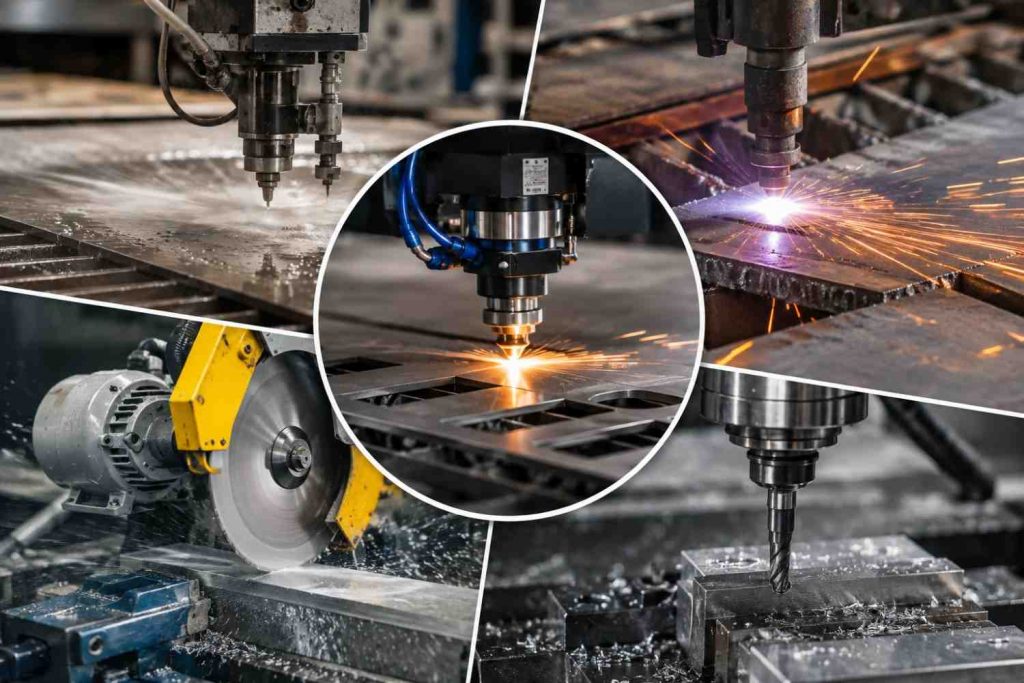
Laser cutting isn’t the only way to separate metal; understanding how it compares to other common processes helps clarify when it’s the right choice.
Laser cutting vs. plasma cutting: Plasma cutting uses an ionized gas jet instead of a light beam, and it’s often chosen for thick, electrically conductive materials where absolute edge precision matters less. Laser cutting produces a narrower kerf, tighter tolerances, and a cleaner edge but plasma is typically faster and less costly on heavy plate.
Laser cutting vs. abrasive waterjet cutting: Waterjet cutting uses a high-pressure stream of water mixed with abrasive particles to erode material away a cold process with zero heat-affected zone. It’s the better choice for heat-sensitive materials or extremely thick stock, but it cuts more slowly than laser on standard sheet metal.
Laser cutting vs. mechanical cutting (shearing/punching): Mechanical methods require physical tooling and blade contact, which means tool wear and setup costs for every new design. Laser cutting eliminates tooling a new part is simply a new CNC program, not a new die. Once a part is cut, many production workflows move straight into forming, which is where how press brake forming works picks up, bending the flat, laser-cut blank into its final shape.
Advantages and Limitations of Laser Cutting
Advantages:
- No physical tooling required; design changes don’t add setup cost
- Extremely tight, repeatable tolerances across full production runs
- Minimal material distortion due to the non-contact process
- Fast turnaround from CAD file to finished part
- Clean edges that often need little to no secondary finishing
Limitations:
- Very thick plate (beyond laser capacity) may still require plasma or waterjet
- Highly reflective metals need careful power tuning to avoid beam back-reflection
- Heat-affected zones, while small, still exist unlike waterjet’s cold-cutting process
Industrial Applications of Laser Cutting
Laser cutting supports a wide range of industrial manufacturing applications because it adapts easily to different thicknesses, geometries, and production volumes:
- Automotive: Brackets and structural components requiring tight tolerances
- Agriculture: Panels and parts built to withstand mechanical stress
- Construction equipment: Heavy-gauge plate requiring dimensional consistency
- Electrical components: Precise cutouts for enclosures and control panels
- Lighting and fixture manufacturing: Intricate, detailed profiles cut directly from sheet metal for housings and decorative panels
These industries rely on laser cutting because design changes require no new tooling, unlike stamping or punching, where every design revision means a new die.
The Role of Laser Cutting in Modern Manufacturing
As manufacturing technology continues to evolve, laser cutting remains central because it bridges digital design directly to physical production. CAD files translate into finished parts with minimal manual intervention, which reduces the variability introduced by manual processes and shortens lead time from design to first article.
This direct digital-to-physical link is also why laser cutting integrates smoothly with automated production lines and Industry 4.0 manufacturing environments; the same CNC program that cuts the first part cuts the ten-thousandth part identically.
Frequently Asked Questions
How is a laser beam generated?
A laser beam is generated by pumping energy into a lasing medium, a doped optical fiber in fiber lasers, or a gas mixture in CO2 lasers, which amplifies light into a concentrated, high-intensity beam.
What are the main steps in the laser cutting process?
The laser cutting process follows six core steps: beam generation, focusing, material interaction, assist gas clearing, CNC-guided motion, and part completion. Each step depends on the one before it to hold consistent tolerances.
How is laser cutting used in industry?
Industrial laser cutting is used to produce precision metal parts for automotive, agricultural, construction, electrical, and lighting applications anywhere tight tolerances and design flexibility matter more than tooling cost.
What affects laser cutting accuracy?
Laser cutting accuracy is affected by focus position, cutting speed, laser power, material thickness, and CNC program precision, all of which work together during the cut.
Which metals are best for laser cutting?
Carbon steel and stainless steel are the most common choices due to predictable melting behavior and clean, consistent edge quality. Aluminium, copper, and brass are cuttable but require more precise parameter tuning due to their reflectivity.
What’s the difference between laser cutting and plasma cutting?
Laser cutting produces a narrower kerf and tighter tolerances, while plasma cutting is generally faster and more economical on very thick plate. The right choice depends on material thickness and tolerance requirements.
Can laser cutting handle complex CAD designs?
Yes, laser cutting handles complex geometries easily because the cutting path is generated directly from digital CAD data rather than physical tooling, so intricate profiles cost no more to produce than simple ones.
Bringing Precision to Your Next Project
Industrial laser cutting works by transforming concentrated light into precise, controlled heat guided by CNC programming and CAD-derived toolpaths. From beam generation to material selection, every stage contributes to the accuracy and repeatability manufacturers depend on.
At RiAlto Manufacturing Inc, our team runs fiber laser technology as part of our full precision cutting capabilities, and we’re always ready to help you navigate the technical side of a project, whether you need to refine a design or scale production. Talk to our engineering team to get a custom fabrication quote for your next run.